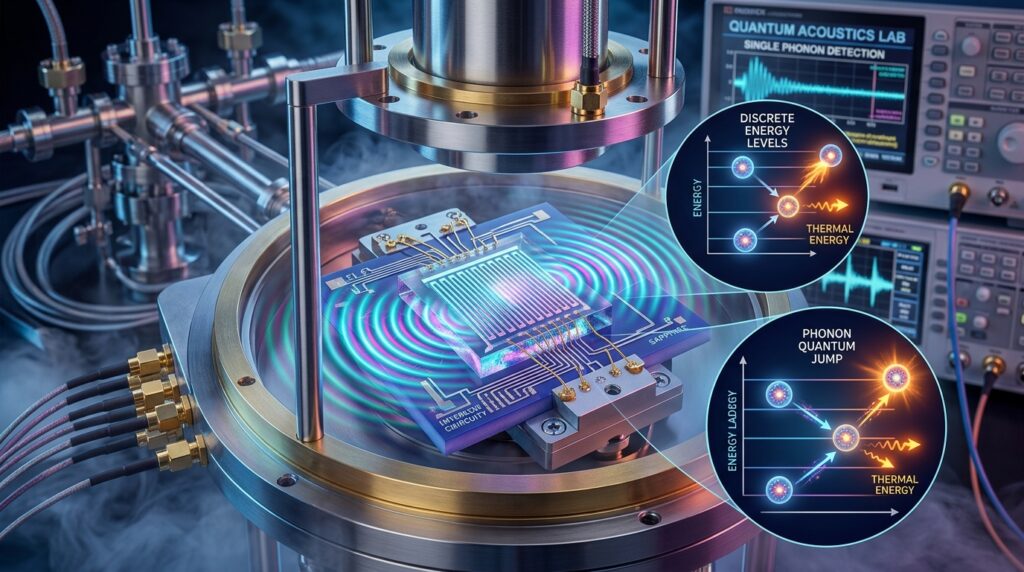
In everyday human experience, sound dies away in a smooth, gentle taper. When a bell tolls, a guitar string vibrates, or a tuning fork hums, the energy dissipates into the surrounding air along what classical physics has always treated as a seamless exponential curve. But deep inside the sub-Kelvin vacuum of a dilution refrigerator, at the ultimate boundary between macroscopic matter and quantum mechanics, nature ceases to fade—it jumps.
In a milestone study published in the journal Science, an applied physics research team at Stanford University has achieved what physicists have pursued for decades: the first direct, real-time observation of quantum jumps of sound. Led by Associate Professor of Applied Physics Amir Safavi-Naeini, alongside co-first authors Takuma Makihara and Erik Szakiel, the researchers demonstrated that microscopic mechanical vibrations do not decay continuously into silence. Instead, they vanish in abrupt, quantized leaps, shedding vibrational quanta known as phonons one packet at a time.
The discovery represents far more than an elegant confirmation of fundamental quantum theory. By proving that mechanical objects composed of billions of atoms can be initialized, tracked, and measured without destroying their delicate quantum superpositions, the Stanford team has unlocked a transformative pathway for acoustic quantum memory, real-time quantum error correction, and high-density phononic computing architectures.
A Century-Long Quest: From Bohr’s Electrons to Macroscopic Sound
The concept of a “quantum jump” has anchored theoretical physics since 1913, when Danish physicist Niels Bohr first postulated that electrons orbiting an atomic nucleus do not spiral between orbits, but abruptly leap between discrete quantized energy levels. For decades, these transitions were considered purely theoretical abstractions that could never be tracked in real time. Erwin Schrödinger himself famously remarked that “we never experiment with just one electron, or atom, or (small) molecule.”
That skepticism unraveled across the late 20th and early 21st centuries through a progression of Nobel-caliber experimental milestones:
- 1986 — Trapped Atomic Ions: Research teams led by Hans Dehmelt and David Wineland isolated single trapped ions, observing the very first real-time optical quantum jumps as single electrons hopped between atomic energy shells.
- 2007 — Photons of Light: French physicist Serge Haroche and his group at the École Normale Supérieure trapped microwave photons between ultra-reflective superconducting mirrors, observing real-time quantum jumps of light as photons vanished one by one without destroying the cavity field.
- September 2026 — Phonons of Sound: The Stanford team extended this frontier to the tangible mechanical realm, observing the birth and death of individual vibrational excitations in a solid crystal lattice.
Sound, however, posed a vastly steeper experimental mountain than electrons or photons. While electrons and photons are fundamental particles that can be isolated in vacuum, a phonon is a collective quasiparticle—the synchronized, rhythmic oscillation of billions upon billions of atomic nuclei bound inside a solid material. Catching a single mechanical phonon jumping between quantum states requires isolating a macroscopic object from all environmental thermal noise, measuring it with extraordinary speed, and avoiding the backaction of the measurement itself.
“For over a century, physics taught us that energy at the quantum scale comes in discrete packets. But observing this in a macroscopic mechanical system—watching sound jump from one energy level to zero in real time—required bridging the gap between quantum electronics and macroscopic acoustic engineering.”
— Amir Safavi-Naeini, Associate Professor of Applied Physics, Stanford University
The Architecture: Trapping Sound in Lithium Niobate
To capture the elusive whisper of a single phonon, the Stanford researchers designed a specialized nanomechanical resonator fabricated from synthetic lithium niobate ($LiNbO_3$). Lithium niobate is widely celebrated for its robust piezoelectric properties—the ability to interconvert mechanical vibrations and electric fields with near-perfect fidelity.
The device, engineered with microscopic dimensions comparable to a tiny tuning fork, functions as an acoustic cavity. Surrounding acoustic mirrors—patterned with microscopic periodic phononic crystal lattices—prevent vibrational energy from leaking into the substrate. This geometric confinement allowed the resonator to sustain acoustic vibrations at microwave frequencies (~5 GHz) with a coherence time exceeding two milliseconds. In the ultra-fast world of quantum mechanics, where operations happen in nanoseconds, two milliseconds is an eternity.
The entire apparatus was cooled inside a dilution refrigerator to approximately 10 millikelvins—barely a fraction of a degree above absolute zero (-273.14°C). At this extreme cryogenic baseline, ambient thermal vibrations are frozen out, leaving the mechanical resonator in its quantum ground state ($n = 0$), stripped of all stray thermal phonons.
The Non-Demolition Measurement: Listening Without Destroying the Sound
The central conundrum of quantum mechanics, rooted in Heisenberg’s uncertainty principle, is that measuring a quantum system typically collapses it or deposits enough energy to annihilate the delicate state being observed. If the researchers tried to “hear” the phonon by absorbing its energy into a detector, the sound would vanish because of the observation itself.
To bypass this obstacle, the Stanford team coupled their lithium niobate mechanical resonator to a superconducting transmon qubit—an artificial two-level atom made of superconducting aluminum and Josephson junctions:
- Dispersive Coupling: Instead of allowing the qubit to directly exchange energy with the resonator, the two systems were detuned, establishing a dispersive interaction where the resonant frequency of the superconducting qubit shifted by a precise amount depending on whether zero, one, or two phonons occupied the acoustic cavity.
- Quantum Non-Demolition (QND) Probing: By interrogating the superconducting qubit with weak microwave pulses, the team could infer the exact number of phonons in the resonator without transferring energy to or from the acoustic mode.
- Stroboscopic Tracking: The researchers performed hundreds of consecutive non-destructive measurements over the two-millisecond lifetime of the vibrational state.
When the team prepared the resonator in a single-phonon state ($n = 1$) and listened, they observed an unbroken plateau of energy—followed by an instantaneous, abrupt drop to zero ($n = 0$). There was no intermediate fade, no fractional energy state, and no smooth transition. The single phonon existed in its entirety, and then, at a precise millisecond timestamp, jumped cleanly into the environment.
Why Phononic Quantum Technology Changes the Hardware Paradigm
The ability to observe and manipulate individual phonons in real time carries profound engineering ramifications for the future of quantum information science and computational hardware. For years, quantum computing architectures have struggled with physical footprint, wiring bottlenecks, and cross-talk decoherence. Quantum acoustics offers a radically different paradigm:
1. 100,000x Slower Velocity & Microscopic Footprint
In vacuum or optical fibers, electromagnetic waves travel at the speed of light ($3 \times 10^8$ m/s). In solid crystals, acoustic waves propagate at roughly 3,000 to 6,000 m/s—approximately 100,000 times slower. Because wavelength is inversely proportional to velocity ($\lambda = v / f$), a 5 GHz microwave electromagnetic photon has a wavelength of several centimeters, necessitating bulky macroscopic cavities. In contrast, a 5 GHz acoustic phonon has a wavelength of less than one micron. This allows thousands of acoustic quantum memories to be densely packed onto a microchip the size of a postage stamp.
2. Real-Time Autonomous Quantum Error Correction
In quantum computation, decoherence—the loss of quantum information to the environment—is the primary obstacle to building fault-tolerant machines. Because the Stanford team can track phonon loss events in real time without destroying the underlying quantum superposition, error-correction algorithms can detect the exact moment a phononic qubit experiences an error, enabling active real-time correction before cascading logical failures occur.
3. The Universal Bridge for Quantum Internet (Transduction)
One of the greatest unsolved challenges in quantum networking is connecting stationary superconducting quantum computers (which operate at microwave frequencies) with flying optical qubits (which transmit over long-distance telecom fiber optics). Superconducting qubits cannot communicate directly with infrared lasers because high-energy optical photons destroy superconductivity. Acoustic phonons bridge this gap: through piezoelectricity, phonons interface seamlessly with microwave qubits, and through optomechanical coupling, they interface with optical light. A lithium niobate phononic resonator acts as the universal quantum transducer, translating microwave data into sound, and sound into light.
4. Unprecedented Quantum Sensing and Metrology
Because phonons represent mechanical motion of atomic nuclei, phononic resonators are exquisitely sensitive to external physical forces. Devices operating at the single-phonon detection threshold could serve as ultra-sensitive gravitational sensors, mass spectrometers capable of weighing individual virus particles or complex proteins, and precision detectors probing hypothetical dark matter particles interacting with crystal lattices.
The Dawn of Quantum Acoustodynamics (QAD)
In the 1980s, the coupling of atoms to light inside optical cavities birthed Cavity Quantum Electrodynamics (CQED). Two decades later, the coupling of artificial atoms to superconducting transmission lines gave rise to Circuit QED, which forms the computational backbone of modern quantum processors at Google, IBM, and Rigetti. Today, Stanford’s breakthrough cements the arrival of a third paradigm: Quantum Acoustodynamics (QAD).
By demonstrating that sound can be quantized, isolated, and tracked in real time at the single-quanta limit, Safavi-Naeini’s laboratory has proven that mechanical matter is not merely a passive substrate for electronic circuits, but an active, programmable medium for quantum information processing.
“Sound has been our species’ oldest medium for sharing spoken ideas. It is deeply poetic that as we engineer the computers of the next century, sound—quantized into individual whispering phonons—may become the medium that stores, protects, and interconnects the quantum universe.”
— LuminousPedia Editorial Analysis
Key Takeaways: Stanford Quantum Jumps of Sound
- The Discovery: Stanford University physicists have captured the first real-time direct observation of quantum jumps in sound, proving mechanical vibrations dissipate in discrete single-phonon steps rather than continuous decay.
- The Architecture: A cryogenic synthetic lithium niobate ($LiNbO_3$) acoustic resonator operating at ~5 GHz with a coherence lifetime exceeding 2 milliseconds at 10 millikelvins.
- Measurement Technique: Quantum Non-Demolition (QND) dispersive coupling to a superconducting transmon qubit, allowing hundreds of measurements without destroying the acoustic quantum state.
- Technological Impact: Paves the way for ultra-compact phononic quantum memories, active quantum error correction, and optical-microwave quantum transducers for the Quantum Internet.