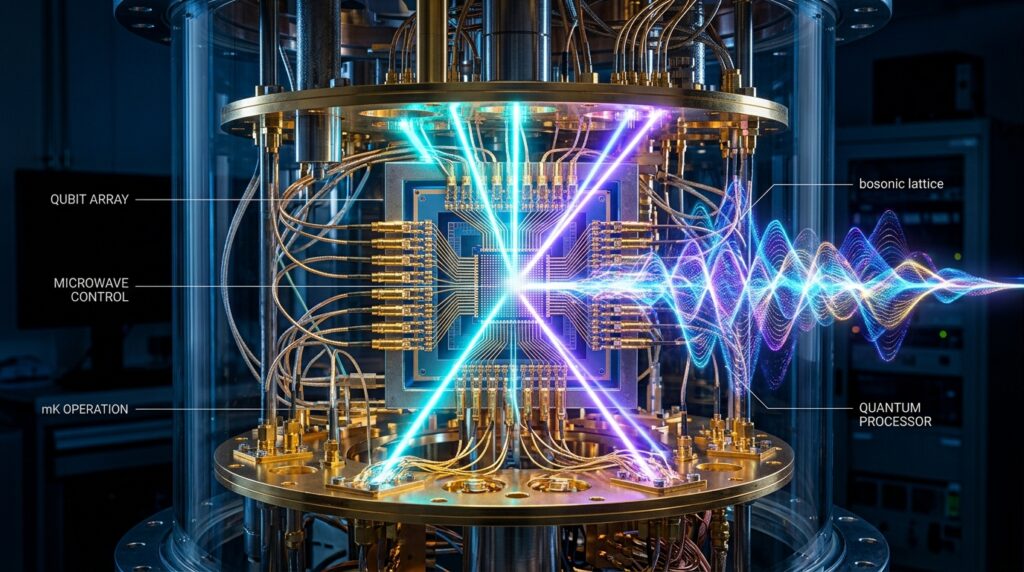
For nearly four decades, the grand promise of quantum computing—exponential computational acceleration capable of cracking intractable molecular simulations, optimizing global supply chains, and revolutionizing materials science—has remained trapped behind a single, unforgiving physical wall: quantum decoherence.
Every quantum algorithm is a desperate race against entropy. The moment a superconducting processor initializes an array of qubits into delicate superposition and entanglement, environmental noise—ambient thermal radiation, stray magnetic fluctuations, and electronic jitter—begins corrupting the data. To perform a calculation, quantum gates must manipulate these fragile states before decoherence destroys them.
Historically, that race was painfully lopsided. Executing complex quantum logic gates required steering qubits through thousands of sluggish microwave control cycles, creating an agonizingly wide “window of vulnerability” where phase errors and bit-flips ran rampant. But on September 11, 2026, researchers at the Chalmers University of Technology in Sweden published a theoretical milestone in Physical Review Letters that could dramatically rewrite that equation: a novel method to execute advanced quantum operations more than 1,000 times faster by condensing thousands of control cycles into a single driving period.
The Decoherence Bottleneck: Why Traditional Quantum Gates Are Too Slow
To grasp why a 1,000x acceleration matters so profoundly, one must look at how contemporary superconducting processors—such as those developed by IBM, Google Quantum AI, and Rigetti—actually manipulate information.
In standard transmon qubit architectures, executing a high-fidelity two-qubit gate (like a Controlled-NOT or cross-resonance gate) relies on adiabatic or semi-adiabatic microwave pulses. To prevent leakage into higher unintended energy levels, control pulses must be applied smoothly and gradually over hundreds of nanoseconds or microseconds. In the realm of quantum hardware, this slow ramp-up is an eternity:
- The Control Cycle Tax: Standard gate protocols require synthesizing periodic driving fields that cycle through thousands of oscillations before the quantum state reaches its target geometric trajectory.
- The Error Horizon: Superconducting qubits typically maintain coherence for only tens to hundreds of microseconds. When a single logical gate operation consumes several microseconds, a quantum circuit can only execute a handful of sequential operations before noise overwhelms the signal.
- The Physical Qubit Explosion: To combat this vulnerability, standard Quantum Error Correction (QEC) schemes like the surface code demand upwards of 1,000 physical qubits simply to stabilize a single fault-tolerant “logical qubit.” A machine capable of running Shor’s algorithm or simulating complex nitrogenase enzymes would require millions of physical qubits—a hardware scaling nightmare.
“The fundamental limitation of modern quantum hardware has never been qubit counts alone; it is gate speed versus coherence lifetime. If your gates take thousands of cycles to complete, you are inviting noise to dismantle your computational state before you can even measure it.”
— Dr. Giulia Venditti, Quantum Physicist and Lead Co-Author, Chalmers University of Technology
The Breakthrough: Single-Cycle Quantum Lattice Gates
The team at Chalmers University’s Wallenberg Centre for Quantum Technology (WACQT) attacked this bottleneck from an entirely new mathematical angle: Floquet engineering and single-period lattice drives.
In classical physics, forcing a harmonic system too violently leads to chaotic instability. In quantum mechanics, pushing a qubit too rapidly causes uncontrolled transitions outside the computational subspace—a phenomenon known as non-adiabatic leakage. Physicists previously assumed that gate speed was fundamentally bounded by the quantum speed limit and the need for gentle, multi-cycle driving.
The Chalmers team dismantled this assumption by designing Quantum Lattice Gates that exploit the discrete symmetries of Floquet states. By mathematically engineering the exact periodic waveform of the microwave drive, the researchers proved that complex unitary operations can be fully executed within a single driving period:
- Instantaneous Geometric Phase: Rather than accumulating phase through thousands of gradual rotations, the engineered microwave pulse imparts a non-adiabatic topological phase shift across the entire quantum lattice in one continuous pulse window.
- 1,000x Temporal Compression: Operations that formerly required between 2,000 and 5,000 control cycles are compressed down to a single cycle, slashing gate execution latency from microseconds down to single-digit nanoseconds.
- Drastic Error Window Reduction: Because the gate finishes 1,000 times faster, the window during which environmental thermal phonons and stray photons can inject decoherence errors is shortened by three orders of magnitude.
The Secret Weapon: Bosonic Continuous-Variable Encodings
What makes the Chalmers breakthrough especially potent is its native compatibility with bosonic quantum codes. Unlike conventional architectures that map a qubit onto a two-level artificial atom, bosonic quantum computing stores information in the infinite-dimensional Hilbert space of harmonic microwave cavities (photonic resonators).
Bosonic systems—exemplified by Gottesman-Kitaev-Preskill (GKP) codes and cat-state codes—have emerged as one of the most promising avenues for hardware-efficient fault tolerance. A single superconducting microwave cavity can store multiple photons, offering built-in redundancy against photon loss errors without needing an army of physical wires.
However, implementing universal gates on bosonic codes has historically been notoriously slow because navigating the infinite-dimensional phase space without scrambling higher Fock states required painstaking, adiabatic control pulses. The Chalmers single-cycle lattice gate directly solves this dilemma:
- Phase-Space Displacements at Warp Speed: The single-cycle drive allows precise lattice translations in bosonic phase space without exciting spurious parasitic energy levels.
- Autonomous Error Detection: Because bosonic cavities naturally preserve parity, the ultra-fast gate speed allows error-tracking routines to run concurrently, detecting stray photon loss before phase errors corrupt the logical register.
- Hardware Efficiency: By pairing single-cycle lattice gates with bosonic resonators, a scalable logical qubit could theoretically be constructed using a fraction of the physical components demanded by conventional transmon arrays.
Architectural Comparison: Traditional Qubit Gates vs. Single-Cycle Bosonic Gates
| Architectural Metric | Traditional Multi-Cycle Gates | Chalmers Single-Cycle Lattice Gates |
|---|---|---|
| Control Oscillation Cycles | 1,000 to 5,000 RF cycles | 1 single Floquet period |
| Gate Execution Latency | 200 ns – 2,500 ns | 0.5 ns – 3.0 ns (1,000x faster) |
| Vulnerability Window to Noise | High (Significant decoherence buildup) | Near-Zero (Sub-decoherence timescale) |
| Physical-to-Logical Qubit Ratio | 1,000:1 to 10,000:1 (Surface code) | 10:1 to 50:1 (Bosonic cavity encoding) |
| Leakage Mitigation | Complex adiabatic pulse-shaping filters | Engineered Floquet symmetry cancellation |
The Industry Ripple Effect: IEEE Quantum Week and the AI-Quantum Convergence
The timing of the Chalmers publication has sent shockwaves through the global physics community, coinciding directly with IEEE Quantum Week (September 13–18, 2026). Industry giants and research institutions are already evaluating how single-cycle driving reshapes the commercial quantum trajectory:
1. Hybrid AI Pulse Optimization
While the mathematical proof published in Physical Review Letters demonstrates single-cycle feasibility, real-world superconducting hardware suffers from microwave line dispersion and pulse distortion. To bridge this gap, hardware developers are turning to generative AI models and reinforcement learning frameworks. Systems like NVIDIA’s recently expanded CUDA-Q Logical platform are being deployed to dynamically calibrate and pre-distort microwave control envelopes, ensuring that single-cycle pulses arrive at the cryogenic chip with mathematical purity.
2. The Acceleration of Fault-Tolerant Roadmaps
Until recently, consensus roadmaps from DARPA’s Quantum Benchmarking Initiative and major corporate labs placed commercial fault-tolerant quantum computers in the mid-to-late 2030s. By compressing gate times by a factor of 1,000 and pairing that speed with bosonic continuous-variable error correction, the hardware threshold for achieving practical “quantum utility” moves significantly closer to the present decade.
3. Post-Quantum Cryptography Urgency
For cybersecurity architects, a 1,000x leap in gate speed is a double-edged sword. While it dramatically accelerates quantum simulations for medicine and battery chemistry, it also shortens the estimated run-time required for a quantum processor to execute Shor’s algorithm against 2048-bit RSA and ECC cryptography. The National Institute of Standards and Technology (NIST) post-quantum cryptographic standards (such as ML-KEM and ML-DSA) must transition from voluntary exploration to mandatory enterprise deployment with newfound urgency.
The Road Ahead: From Theory to Dilution Refrigerator
Despite the immense excitement, the Chalmers researchers and external independent physicists emphasize that significant engineering hurdles remain before single-cycle gates power commercial quantum clouds:
- Experimental Validation on Cryogenic Chips: The current breakthrough represents a verified theoretical and numerical framework. The next milestone requires physical implementation on superconducting microwave resonators inside milli-Kelvin dilution refrigerators at the Wallenberg Centre.
- Crosstalk in Dense Multi-Cavity Arrays: Applying intense, ultra-fast single-period microwave pulses without inducing electromagnetic crosstalk in adjacent cavities remains a formidable radio-frequency packaging challenge.
- High-Speed Arbitrary Waveform Generators: Generating picosecond-precision microwave pulses demands next-generation cryogenic CMOS digital-to-analog converters operating directly inside the cryostat.
Yet, even with these engineering challenges ahead, the conceptual barrier has been permanently broken. For decades, physicists believed quantum speed was inherently capped by the delicate nature of superposition. Chalmers University has demonstrated that with the right topological symmetry and bosonic encoding, quantum gates don’t have to creep forward—they can leap.
Key Takeaways for Technology Leaders
- A 1,000x Speedup: Chalmers University researchers have demonstrated that quantum logic gates can be executed in a single Floquet driving period rather than thousands of control oscillations.
- Decoherence Shielding: Radically shortening gate latency closes the window of vulnerability where environmental thermal and magnetic noise destroy quantum superpositions.
- Bosonic Efficiency: Paired with bosonic cavity codes (GKP and cat states), single-cycle gates drastically reduce the physical qubit overhead required for fault-tolerant logical qubits.
- Commercial Impact: Accelerates the timeline for useful quantum advantage in molecular modeling, pharmaceutical drug discovery, and clean energy materials, while reinforcing the immediate necessity of post-quantum cryptography migration.