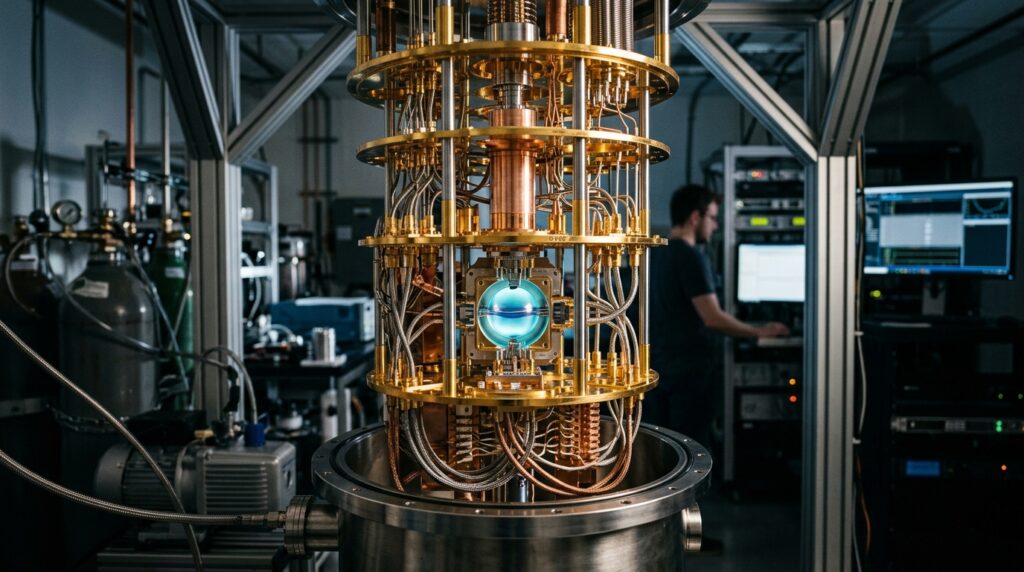
The defining bottleneck holding quantum computing back from commercial utility has never been a shortage of sophisticated algorithms or mathematical promise; it has been the unforgiving physics of environmental noise. For three decades, quantum engineers have wrestled with decoherence—the instantaneous collapse of fragile quantum superpositions triggered by the slightest thermal, magnetic, or electrical whisper from the surrounding environment. In modern solid-state processors like superconducting transmons, this enemy is ubiquitous: stray two-level systems, amorphous surface oxides, and random electrostatic fluctuations embedded within the silicon or sapphire chips themselves.
That fundamental material limitation may have finally met its match. In a landmark study published in npj Quantum Information on October 1, 2026, researchers from the Quantum Sciences Group at the University of Surrey unveiled the Superfluid Helium Oscillator Quantum (SHOQ) device—the world’s first conceptual qubit engineered entirely within a matrix of ultra-cold superfluid helium-3 ($^3\\text{He}$). By substituting solid-state metallic junctions with an atomically pristine, charge-neutral quantum fluid, the team’s rigorous theoretical and numerical models predict that the SHOQ architecture can slash intrinsic operational error rates by up to 100 times compared to industry-standard superconducting circuits.
The Solid-State Trap: Why Superconducting Qubits Hit a Coherence Wall
To appreciate why the Surrey breakthrough has sent ripples through the international quantum physics community, one must examine the physical traps inherent in current hardware. Today’s most visible quantum computing architectures—such as the superconducting transmon circuits developed by IBM, Google, and Rigetti—rely on microscopic loops of superconducting metals like aluminum and niobium deposited onto planar sapphire or high-resistivity silicon wafers. Non-linear Josephson junctions, formed by ultra-thin aluminum oxide barrier layers, grant these circuits the non-equidistant energy spacing required to isolate computational |0⟩ and |1⟩ basis states.
Yet the very materials that make these circuits nanofabricable are also their undoing. At the atomic scale, solid-state substrates are rarely uniform crystals:
The Dielectric Loss Problem
Amorphous oxide coatings and microscopic chemical residues introduce fluctuating dipole moments known as Two-Level Systems (TLS). These microscopic defects act as parasitic energy sponges, absorbing microwave photons emitted by the qubit and destroying the energy relaxation lifetime (T1).
The Electrostatic Charge Trap
Because superconducting currents consist of charged Cooper pairs (paired electrons with charge 2e), any stray charge fluctuation in the substrate or nearby control lines directly shifts the qubit’s resonance frequency. This jitter leads to rapid dephasing (T2*), corrupting quantum information before complex multi-gate algorithms can complete.
The practical consequence is staggering. To protect quantum information against these pervasive errors, computer scientists must implement quantum error correction (QEC) protocols such as surface codes. However, because each physical qubit is inherently noisy, current architectures require hundreds or even thousands of physical “ancilla” qubits to synthesize a single fault-tolerant logical qubit. This “ancilla overhead explosion” has turned the road toward scalable commercial quantum computation into an exorbitantly expensive scaling war.
KEY ARCHITECTURAL ADVANTAGES: THE SURREY SHOQ DEVICE
- Absolute Electrical Neutrality: Helium-3 atoms carry zero net electric charge, providing innate physical immunity to stray 1/f charge noise and patch potentials.
- Zero Substrate Defects: Superfluid helium-3 forms a defect-free, self-healing quantum liquid with no crystal grain boundaries, chemical impurities, or surface oxidation.
- 100-Fold Error Suppression: Analytical modeling published in npj Quantum Information indicates gate error rates down to 10-5, roughly two orders of magnitude cleaner than conventional transmons.
- Topological Symmetry Protection: Below 2.5 millikelvin, helium-3 enters a topological p-wave superfluid state, offering built-in macroscopic quantum hydrodynamic coherence.
- Hybrid Memory Viability: Operates at microwave cavity frequencies compatible with existing circuit-QED infrastructure, enabling seamless integration as long-lived quantum memory.
The Physics of SHOQ: Constructing a Qubit from Superfluid Helium-3
Led by Dr. Priya Sharma, the Quantum Sciences Group at Surrey took a radically different path: rather than attempting to incrementally polish solid-state surfaces, they abandoned solid conductors altogether in favor of a macroscopic quantum fluid.
Helium-3 is an extraordinarily rare, light isotope of helium consisting of two protons and a single neutron. Because its nucleus possesses a half-integer nuclear spin (I = 1/2), helium-3 atoms are fermions. Unlike ordinary helium-4 (a boson that undergoes Bose-Einstein condensation at 2.17 Kelvin), helium-3 requires temperatures below approximately 2.5 millikelvin—just thousandths of a degree above absolute zero—to achieve superfluidity. At this cryogenic threshold, pairs of helium-3 atoms form delicate fermion pairs analogous to Cooper pairs in superconductors, but with a crucial distinction: they bind with orbital angular momentum (p-wave pairing), creating an anisotropic, topological quantum fluid.
In the SHOQ design, a minute volume of superfluid helium-3 is confined within a microfabricated resonant acoustic and microwave cavity. By coupling the hydrodynamic oscillations of the topological fluid to high-Q superconducting microwave resonators through sub-micron electrostatic diaphragms or acoustic wave transducers, the researchers induce quantized, non-linear energy levels in the fluid’s collective degrees of freedom.
“Solid-state qubits are fundamentally trapped by the chemistry of materials—no matter how cleanly you polish a silicon wafer, you are always fighting surface oxides, lattice dislocations, and stray trapped charges,” explains Dr. Priya Sharma, lead author and UKRI Fellow. “Superfluid helium-3 is nature’s purest quantum state. It has no lattice, no defects, and zero electrical charge. By building a qubit out of the fluid’s collective quantum dynamics, we eliminate the primary noise mechanisms that have throttled quantum coherence for thirty years.”
Comparative Hardware Benchmarks: Why Fluid States Change the Equation
To contextualize the magnitude of Surrey’s theoretical breakthrough, it is helpful to evaluate how the SHOQ architecture stacks up against today’s four leading quantum modalities across critical physical metrics:
| Qubit Modality | Primary Decoherence Mechanism | TLS Defect Sensitivity | Baseline Error Rates (2-Qubit) | Core Scaling Bottleneck |
|---|---|---|---|---|
| Superconducting Transmon | Substrate dielectric loss, 1/f charge & flux noise | Extreme (oxide interfaces) | ~10-3 to 10-2 | Ancilla overhead; material defects; cross-talk |
| Trapped Ions | Anomalous motional heating, laser phase jitter | Negligible (vacuum trapped) | ~10-3 | Gate operation speed; complex shuttle optics |
| Neutral Atom Arrays | Atomic beam heating, Rydberg laser spontaneous decay | None (optical tweezers) | ~10-3 | Laser power limits; atom loss during readout |
| Surrey SHOQ ($^3\text{He}$) | Residual acoustic damping, thermal quasiparticles | Virtually Zero (Defect-Free Fluid) | ~10-5 (Projected) | Sub-2.5 mK cryogenic cooling; cavity coupling |
The numerical modeling indicates that because the dielectric loss tangent ($\tan \delta$) of bulk liquid helium-3 approaches zero, energy relaxation times (T1) can potentially be extended by several orders of magnitude into the millisecond or second domain. Simultaneously, because charge-noise dephasing is suppressed by the neutrality of the helium-3 nucleus, the pure dephasing time (T2*) closely tracks the fundamental relaxation limit, unlocking gate fidelities well beyond 99.99%.
The £1.3M Roadmap: From Analytical Proof to Laboratory Prototype
The publication in npj Quantum Information coincided with another milestone for the Surrey team: the formal award of a £1.3 million UKRI Future Leaders Fellowship to Dr. Priya Sharma. This multi-year funding tranche is specifically allocated to transition the SHOQ concept from analytical physics into experimental silicon-microfluidic reality.
Bringing a superfluid helium qubit from blueprint to benchtop involves addressing three primary technical hurdles:
- Sub-Millikelvin Cryogenics: Superfluid $^3\text{He}$ requires operating temperatures below 2.5 mK, well colder than standard dilution refrigerators (~10–15 mK). The Surrey roadmap leverages miniaturized nuclear demagnetization refrigeration stages mounted directly on commercial dilution cryostats—a mature technique in low-temperature research laboratories that is now being miniaturized for quantum computing testbeds.
- Microfluidic Cavity Fabrication: Confining the fluid requires deep reactive-ion etched (DRIE) silicon cavities sealed with atomically smooth quartz windows to prevent capillary turbulence and localized vortex pinning.
- Hybrid Circuit-QED Interfacing: Rather than attempting to replace all existing microwave electronics, Surrey’s architecture is explicitly designed to interface with standard circuit-QED coplanar waveguides. This positions the SHOQ device as an ideal candidate for quantum memory cells—dense, long-lived storage nodes that hold quantum data while fast superconducting processors execute logical gate operations.
Shattering the Quantum Overhead Barrier
The broader implications of the SHOQ platform extend far beyond academic novelty. In the race toward commercially transformative quantum advantage, the ultimate prize is fault-tolerant quantum computing—machines capable of running millions of gates to crack post-quantum cryptography, simulate enzymatic nitrogen fixation, or design novel room-temperature superconductors.
Under current error models, building a 10,000-logical-qubit computer requires between 5 million and 20 million physical qubits, an engineering undertaking comparable to building an aircraft carrier inside a vacuum chamber. If physical qubit error rates can genuinely be suppressed by a factor of 100—as the Surrey simulations suggest—the required code distance of surface codes collapses precipitously. The physical-to-logical qubit ratio could drop from 1,000:1 down to 50:1 or even lower.
By stepping beyond the rigid constraints of solid-state lithography and harnessing the pristine quantum symmetry of superfluid helium-3, Dr. Sharma and her team at Surrey have opened an electrifying new front in quantum physics. As experimental prototypes begin fabrication in Guildford over the coming months, the quantum community will be watching closely to see if fluid mechanics holds the ultimate key to conquering quantum noise.