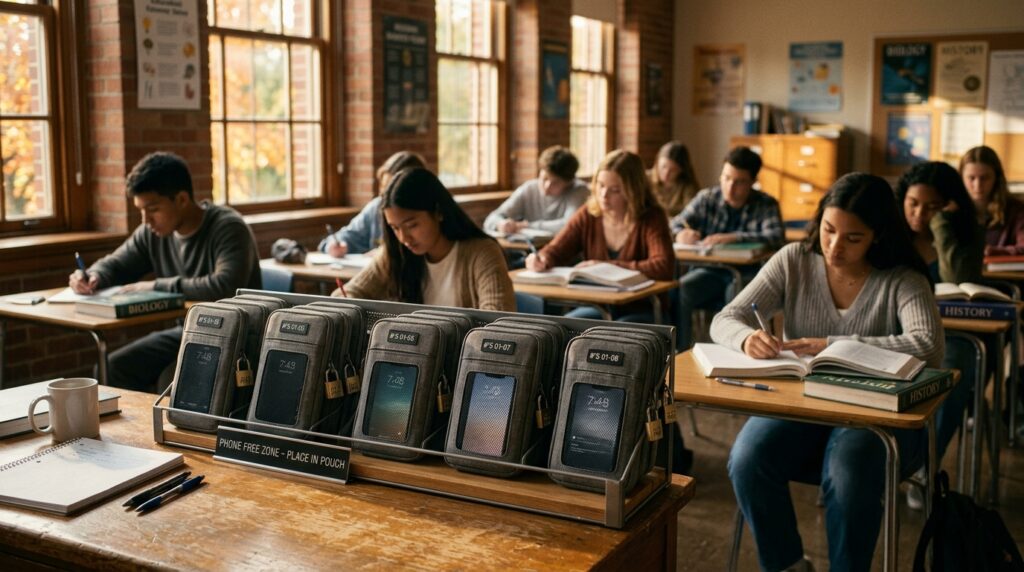
Across tens of thousands of middle and high schools this autumn, the morning routine of modern adolescence has undergone its most dramatic physical reconfiguration in a generation. From California, where the Phone-Free Schools Act (AB 3216) took sweeping operational effect, to England’s nationwide statutory bans and similar mandates spanning over forty U.S. states and dozens of countries, millions of students now begin their school day not with a screen swipe, but with the snap of a magnetic lock.
The promise that catalyzed this global legislative tsunami was intuitively straightforward: if educators could physically sever teenagers from the dopamine-engineered algorithms of TikTok, Instagram, and Snapchat for seven hours a day, the chronic attention fragmentation plaguing contemporary classrooms would heal. Disruptions would evaporate, mental health would stabilize, and standardized test scores—battered by years of post-pandemic stagnation—would stage an inevitable renaissance.
Yet as the first comprehensive, multi-district empirical cohorts from Fall 2026 arrive, the reality emerging from econometric analysis and cognitive neuroscience has delivered a profound shock to educational policymakers. The silence in the hallways has returned, but the academic miracle has not.
The Empirical Shock: The Landmark NBER Nationwide Findings
For years, school phone prohibitions were evaluated through anecdotal teacher surveys, self-reported student sentiment, or isolated pilot studies vulnerable to the Hawthorne effect. That empirical fog cleared decisively with the publication of the largest nationwide evaluation of school phone bans to date, spearheaded by researchers affiliated with the National Bureau of Economic Research (NBER) led by Hunt Allcott.
Analyzing extensive data across hundreds of secondary schools utilizing lockable pouch systems—such as Yondr—the researchers documented undeniable operational victories alongside a glaring academic disconnect:
- Classroom Disruption Plummeted: Daily teacher-reported phone distractions fell precipitously, tumbling from over 60 percent of instructional time down to roughly 13 percent. Corridors became visibly calmer, and illicit in-class video filming virtually vanished.
- Disciplinary Dynamics Shifted: While strict enforcement generated an initial friction spike during the first few weeks—producing a temporary wave of administrative infractions for pouch tampering—overt classroom defiance settled markedly over time.
- Academic Test Scores Barely Budged: Despite the restoration of classroom decorum, the aggregate impact of bell-to-bell phone bans on standardized academic performance across math, reading, and science hovered stubbornly close to zero.
“Removing the device eliminates the acute interruption, but it does not automatically install the apparatus of cognitive engagement,” observes educational policy analyst Dr. Aris Thorne. “We mistook the absence of a distraction for the presence of learning.”
The NBER findings revealed a crucial developmental bifurcation that policymakers completely overlooked. In high schools, where curricula demand sustained sequential reasoning, students recorded modest, statistically significant gains in higher-level mathematics. However, in middle schools (grades 6 through 8), the policy frequently registered negligible or slightly negative impacts on standardized outcomes. In younger adolescents, the abrupt confiscation of digital social lifelines frequently manifested as restlessness, ambient peer conflict, and internal agitation rather than spontaneous academic absorption.
The “Behavioral Compensation” Trap: What Happens After 3:00 PM
To understand why the removal of seven hours of daily screen access failed to register as higher GPA points or cognitive breakthroughs, researchers had to look past the schoolhouse gate. A landmark September 2026 study from Ghent University, monitoring continuous device telemetry and physiological markers among adolescents subjected to strict school bans, uncovered what behavioral economists term acute digital compensation.
The data demonstrated that locking away phones during the school day did not meaningfully decrease a student’s total 24-hour screen exposure. Instead, the adolescents engaged in hyper-compressed, aggressive device binging the instant the magnetic pouches were unlocked at the afternoon dismissal bell.
The Rebound Window
Between 3:30 PM and dinner, students absorbed notifications at twice their historical baseline velocity. Group chats, social media feeds, and mobile gaming sessions were crammed into frantic afternoon intervals, elevating cortisol levels and cognitive exhaustion right when homework and reflective study were meant to occur.
The Sleep Cannibalization Effect
More critically, the backlog of unmet digital interactions bled directly into the nocturnal hours. Students reported extending screen usage past midnight to reclaim their lost peer socialization—directly sabotaging slow-wave sleep and REM phases where long-term memory consolidation and synaptic pruning take place.
The neurological consequences of this compensation are devastating to academic achievement. A pupil can sit in an immaculate, phone-free chemistry classroom at 10:00 AM, but if their hippocampal memory consolidation was derailed at 2:00 AM by blue-light induced sleep fragmentation, the biological substrate required to retain organic reaction mechanisms is fundamentally compromised.
The Cognitive Illusion: Why Silence Does Not Equal Focus
Beyond behavioural compensation lies a deeper neurobiological reality highlighted by researchers at the newly announced £3 million Educational Neuroscience Policy Research Centre, established jointly by University College London (UCL) and Birkbeck under the auspices of the UK Department for Education. Cognitive neuroscientists emphasize that attention is not a vacuum created by removing a smartphone; it is an active, metabolically demanding construct governed by the prefrontal cortex.
In cognitive architecture, the human brain toggles between several macroscopic neural networks:
- The Central Executive Network (CEN): Responsible for active working memory, sustained analytical reasoning, and deliberate cognitive effort.
- The Salience Network: Constantly scanning internal and external environments for biologically urgent or emotionally rewarding cues.
- The Default Mode Network (DMN): The network activated during daydreaming, mind-wandering, internal narrative, and unfocused rest.
For more than a decade, algorithmic feeds on social media platforms have hyper-stimulated the salience network, conditioning developing brains to anticipate high-frequency novel stimuli every 15 to 30 seconds. When a school locks a smartphone inside a canvas or neoprene pouch, it eliminates the external salience cue—the buzzing notification or glowing lock-screen icon. However, it does not re-wire the underlying attention circuitry.
Without intentional pedagogical interventions, a brain conditioned for high-velocity dopamine loops does not automatically default to the Central Executive Network when a textbook is placed before it. Instead, deprived of its external feed, the brain drops straight into the Default Mode Network: involuntary mind-wandering, apathy, and cognitive disassociation. The student appears compliant and silent to the instructor, yet their neural processing remains fundamentally disconnected from the instructional material.
Beyond the Pouch: The Four Pillars of True Attention Architecture
The takeaway from Fall 2026 is emphatically not that smartphones belong back on students’ desks. School administrators and educators overwhelmingly affirm that phone-free spaces have rescued classrooms from physical anarchy and toxic social media filming. The lesson is that physical prohibition is merely Phase 0—an environmental clearing of the brush that accomplishes nothing unless purposeful architecture is constructed upon the cleared ground.
The forward-thinking school districts that did achieve statistically significant academic gains alongside phone bans implemented a four-part neuro-pedagogical framework:
1. Explicit Metacognitive Scaffolding
Rather than treating the ban as a punitive disciplinary measure, top-performing schools teach students the cognitive science of their own brains. Pupils learn about cognitive load theory, attention residue, and the biological metabolic cost of task-switching. When students understand that their working memory holds only four to seven chunks of information at once, self-regulation shifts from an oppressive adult mandate to an empowering personal skill.
2. Replacing Passive Lectures with Active Cognitive Friction
A silent lecture is just as vulnerable to daydreaming as a noisy classroom is to texting. Schools seeing genuine academic leaps have transitioned their newly quiet periods into high-engagement, active learning formats: Socratic seminars, peer-led problem solving, physical lab experimentation, and structured debates. Deep cognitive encoding requires productive struggle; learning must be active, discursive, and rigorous.
3. Graduated Digital Literacy and Intentional Tool Integration
Total abstinence during the school day followed by unmonitored digital chaos at home leaves adolescents completely unprepared for adulthood. Innovative schools establish dedicated, supervised computer-lab cohorts where students are taught how to utilize generative AI and digital research engines critically, verifying citations and pressure-testing algorithmic outputs rather than passively consuming them.
4. Parental and Circadian Partnerships
Because the academic battle is frequently lost after 10:00 PM, districts with rising test scores initiated comprehensive parent education campaigns. By coordinating with families to establish home docking stations outside bedrooms, schools closed the loop on nighttime behavioral compensation, protecting the restorative sleep cycles necessary for neuroplasticity.
The Verdict: An Essential Triage, Not a Magic Wand
The smartphone ban wave of Fall 2026 has exposed a fundamental truth about educational reform: there are no hardware shortcuts to intellectual growth. Locking away three hundred iPhones in a cabinet will silence a room, but it will not teach a child calculus, historical analysis, or critical prose.
The magnetic pouch is a tourniquet. It was desperately necessary to halt the hemorrhaging of classroom attention caused by unregulated Big Tech algorithms. But a tourniquet only stops the bleeding—it does not rebuild muscle, heal fractured bone, or teach the patient to walk again. As schools look forward to the remainder of the 2026–2027 academic year, the task is no longer about policing the lockbox. It is about revitalizing the human pedagogy that happens once the lock clicks shut.