Why do our bodies fail in unison? For over a century, biomedical science treated the aging process as an inevitable, decentralized collapse: heart valves calcify, kidneys lose filtration capacity, skeletal muscles lose contractile fiber, and neurons succumb to neurofibrillary tangles and synaptic starvation. Each organ was studied in isolation, treated by dedicated specialists, and viewed through the prism of independent stochastic wear-and-tear.
Yet anyone who has observed the arc of human senescence recognizes an undeniable paradox: different organs, despite performing radically different physiological duties, tend to age on remarkably synchronized timetables. Now, a landmark study published in Science by a Stanford Medicine research team led by Dr. Katrin Andreasson has uncovered the biological master key behind this synchronized decline. The degradation of our most vital tissues is not caused by thousands of unrelated breakdowns—it is driven by the catastrophic failure of a single immune waste-disposal mechanism governed by one molecular receptor.
Even more extraordinary, the Stanford team demonstrated that by therapeutically flipping this single “immune switch,” they could restore cellular waste disposal, halt systemic tissue degradation, and rejuvenate the brain, heart, kidneys, and skeletal muscle in aged mammals.
The Body’s Hidden Garbage Crew: Tissue-Resident Macrophages
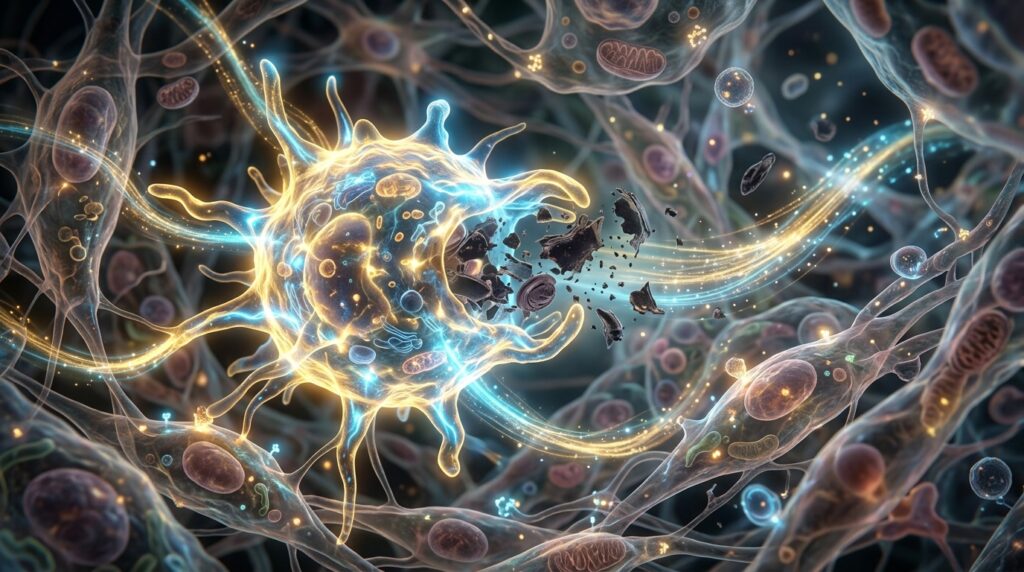
To understand the breakthrough, one must zoom into the microscopic architecture of our organs. Embedded permanently within nearly every tissue of the human body is a specialized population of immune sentinels known as tissue-resident macrophages. In the brain, they are called microglia; in the liver, Kupffer cells; in the heart, cardiac macrophages.
While macrophages are famous for neutralizing bacterial pathogens, their primary everyday obligation is vastly more routine—and biologically foundational: cellular efferocytosis. Every single day, the human bone marrow churns out approximately 100 billion neutrophils—front-line white blood cells designed to patrol the bloodstream. Neutrophils possess a lethal biochemical arsenal of enzymes, reactive oxygen species, and antimicrobial peptides. However, their lifespan is brief: within 24 hours, billions of worn-out neutrophils undergo programmed cell death (apoptosis) across our tissues.
“Tissue-resident macrophages are the sanitation workers of human biology,” explains senior author Dr. Katrin Andreasson, professor of neurology and neurological sciences at Stanford Medicine. “When billions of dying neutrophils enter tissue spaces, macrophages must engulf and digest them instantly. If the garbage is not collected, the bags burst, spilling toxic inflammatory chemicals directly into healthy cells.”
The Stanford researchers discovered that as mammals age, this critical sanitation mechanism suffers a systemic collapse. Macrophages do not simply grow tired; they undergo a specific biochemical paralysis that prevents them from recognizing and consuming apoptotic neutrophils. Stranded within vital organs, dying neutrophils undergo secondary necrosis, rupturing and saturating surrounding tissues with destructive proteases and inflammatory cytokines—a catastrophic phenomenon known as inflammaging.
The Malfunctioning Switch: How the PGE2-EP2 Axis Paralyzes Immune Cells
Why do macrophages abandon their cellular housekeeping duties as we age? By conducting extensive multi-omic sequencing and metabolic profiling on aged macrophages, the Stanford team isolated the exact molecular culprit: the EP2 receptor.
As organisms grow older, tissues produce steadily increasing concentrations of prostaglandin E2 (PGE2)—a lipid autacoid hormone typically mobilized during acute pain and injury. When excess PGE2 binds persistently to the EP2 receptor on tissue-resident macrophages, it triggers an aberrant intracellular signaling cascade that sabotages cellular energy metabolism:
- Glycolytic Shutdown: PGE2 binding forces macrophages to convert incoming glucose into stored glycogen rather than utilizing it for immediate ATP production through glycolysis.
- Mitochondrial Arrest: Starved of metabolic fuel, the mitochondria within macrophages enter a state of functional arrest, depriving the cell of the energy required to extend its cellular arms (pseudopodia).
- Efferocytosis Failure: Paralyzed and depleted of ATP, the aged macrophage sits motionless, entirely unable to ingest neighboring senescent neutrophils.
This single pathway explains why chronic low-grade inflammation rises exponentially in mid-to-late life. The immune system is not attacking the body out of an autoimmune error; it is drowning in its own uncollected biological debris.
The Reversal Experiment: Rejuvenating Eight Organs Simultaneously
Having pinned down the PGE2-EP2 mechanism, Dr. Andreasson’s laboratory posed the critical question: what happens if you selectively disable this single receptor in aged animals?
Using both genetic knockouts and a potent small-molecule EP2 receptor antagonist, the researchers treated aged mice equivalent in biological age to 70-year-old humans. The therapeutic outcome exceeded all theoretical expectations. Within weeks of blocking the EP2 receptor, tissue-resident macrophages restored their youthful glycolytic flux, resumed aggressive efferocytosis, and systematically purged the accumulated necrotic debris from organ tissues.
The Untreated Aged Macrophage
Hyper-activated by PGE2, locked in glycogen storage mode, energy-starved, incapable of clearing dying neutrophils. Causes chronic tissue scarring, neuroinflammation, and multi-organ degeneration.
The EP2-Inhibited Rejuvenated Macrophage
EP2 signaling blocked, robust mitochondrial ATP generation restored, rapid efferocytic clearance of cellular debris. Eliminates inflammaging and preserves healthy organ microenvironments.
The systemic physiological regeneration observed across the animals was breathtaking in its scope:
- Cognitive Recovery & Brain Health: In the brain, microglia resumed clearance of toxic debris and synaptic fragments. Aged mice exhibited a dramatic reduction in neuroinflammation, enhanced hippocampal long-term potentiation (LTP), and regained spatial learning and navigational memory performance equivalent to young adult mice in Barnes maze and novel-object recognition trials.
- Cardiac Rejuvenation: In the heart, eliminating uncollected neutrophil necrosis halted the progression of myocardial fibrosis, resulting in measurably enhanced left ventricular ejection fraction and arterial elasticity.
- Reversal of Sarcopenia & Frailty: In skeletal muscle, cleared interstitial spaces allowed myogenic satellite cells to repair muscle fibers, dramatically increasing grip strength, endurance on treadmill stress tests, and rotarod motor coordination while reducing overall frailty indices.
- Metabolic & Visceral Homeostasis: Treated animals demonstrated reduced ectopic visceral adiposity, lowered circulating blood levels of pro-inflammatory interleukin-6 (IL-6) and tumor necrosis factor-alpha (TNF-α), and improved glomerular filtration rates in the kidneys.
The Paradigm Shift: From Fragmented Disease to Unified Healthspan
The implications of the Stanford discovery extend far beyond mouse physiology; they challenge the foundational structure of modern clinical medicine. For decades, the biopharmaceutical sector has developed bespoke treatments for individual chronic conditions: statins for heart disease, anti-amyloid monoclonal antibodies for Alzheimer’s, and anti-fibrotic compounds for kidney failure.
However, if multi-organ deterioration shares a common biological root—the failure of macrophage efferocytosis driven by the PGE2-EP2 receptor—then longevity therapeutics can pivot from treating isolated symptoms to repairing core cellular sanitation.
Because EP2 antagonists target an immune signaling receptor rather than a disease-specific lesion, they represent an entirely new class of pan-organ therapeutics. Biotech firms and academic consortia are already accelerating medicinal chemistry efforts to develop brain-penetrant, high-selectivity EP2 inhibitors suitable for human clinical safety trials.
Actionable Insights: How to Support Cellular Cleanup Today
While pharmacological EP2 inhibitors navigate translational pipelines and clinical trials, the molecular mechanisms illuminated by Dr. Andreasson’s research provide immediate, evidence-backed lifestyle insights for optimizing macrophage health and mitigating PGE2-driven inflammaging:
- Optimize Omega-3 to Omega-6 Fatty Acid Ratios: Prostaglandin E2 (PGE2) is directly synthesized from arachidonic acid, an omega-6 polyunsaturated fatty acid. High dietary ratios of EPA and DHA (found in wild cold-water fish and algae oils) competitively inhibit the cyclooxygenase enzymes responsible for PGE2 production, dampening baseline inflammatory tone.
- Prioritize Deep Slow-Wave Sleep for Microglial Cleaning: The glymphatic system and brain microglia perform the bulk of their waste-clearing efferocytosis during deep, slow-wave non-REM sleep. Maintaining consistent sleep timing and optimizing restorative sleep architecture protects cerebral cleanup crews.
- Sustained Resistance Training to Stimulate Myokine Flux: Contracting skeletal muscle secretes anti-inflammatory myokines (such as IL-15 and decorin) that modulate tissue-resident macrophage polarization from an inflammatory M1 state back to a reparative, efferocytic M2 phenotype.
- Metabolic Spacing and Fasting Mimicry: Periodic caloric restriction and time-restricted eating stimulate cellular autophagy and lower baseline insulin signaling, preventing excessive macrophage glycogen accumulation and preserving mitochondrial flexibility.
Aging was once perceived as an unalterable decay programmed into every strand of our DNA. But the Stanford breakthrough tells a very different story: our cells do not lose the capacity to remain young—they merely become suffocated beneath their own biological waste. By restoring the cellular cleanup crew, science has taken its most decisive step yet toward extending human healthspan, proving that the boundary between biological decline and molecular renewal is governed by a switch we now know how to turn.