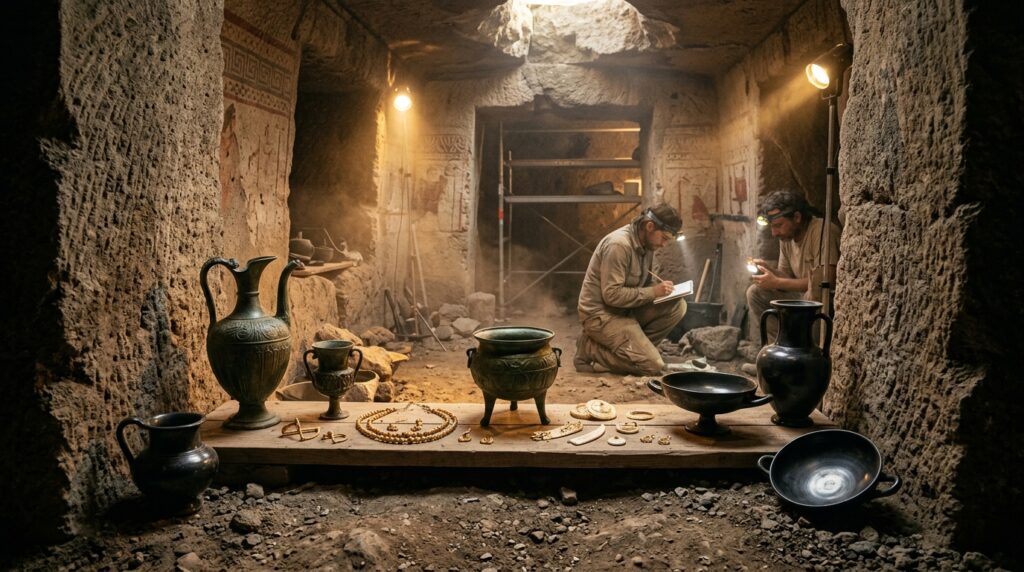
In the autumn of 1889, the pioneering French archaeologist Stéphane Gsell stood on the wind-swept tuff plateau of the Polledrara necropolis, just north of the ancient city of Vulci in central Italy. Methodically pacing out the perimeter of an enormous earthen tumulus, Gsell recognized that an elite monument lay buried beneath the pastureland. Yet, constrained by nineteenth-century excavation methods and the perilous instability of subterranean volcanic rock, he was forced to abandon his search before locating the central burial chamber. For 137 years, the mound retained its secret, slowly receding into archaeological folklore as an elusive phantom of archaic Etruria.
In late September 2026, that century-old mystery finally ended. Led by the international research initiative “Return to Vulci”—operating under concession from the Italian Ministry of Culture and directed by archaeologists Laura Maria Michetti, Alessandro Conti, and Christian Mazet—an excavation team successfully breached the lost heart of the Gsell Tumulus. What they revealed is nothing short of extraordinary: the monumental “Tomb of the Stone Chamber” (Tomba della Camera di Pietra), an undisturbed princely funerary complex dating back 2,700 years to the late 7th century BCE.
The Architecture of Power: The “Tomb of the Stone Chamber”
Dating to the apex of the Etruscan Orientalizing period (circa 630–600 BCE), the newly uncovered tomb represents one of the most structurally sophisticated archaic burial complexes identified in the Tyrrhenian basin in decades. Carved directly into the local volcanic tuff bedrock and framed by cyclopean ashlar stone blocks, the complex was accessed through a deeply recessed descending corridor (dromos) engineered to withstand millennia of seismic settling.
Monumental Engineering
Constructed during Vulci’s golden age of aristocratic state formation, the burial chamber features precision-cut monolithic stone lintels and a load-bearing corbelled ceiling designed to support hundreds of tons of earthen tumulus overburden.
The Gsell Tumulus Scale
Initial geophysical surveys conducted alongside the 2026 excavation reveal that the encompassing tumulus mound spans a diameter far exceeding nineteenth-century estimates, placing it in direct architectural competition with Vulci’s famed Cuccumella tumulus.
The interior architecture reveals an intricate layout of funerary benches, ritual niches, and stone platforms that served as the final resting place for a dynastic family of the highest social order. Despite scattered evidence of clandestine tunneling attempts during the mid-twentieth century, the tomb’s primary structural vaults and deepest ceremonial deposits remained intact, preserving a pristine archaeological assemblage from the dawn of Mediterranean classical antiquity.
ARCHAEOLOGICAL DOSSIER: THE POLLEDRARA NECROPOLIS
- Location: Ancient Vulci, Viterbo / Maremma Region, Lazio, Italy
- Chronology: Late Orientalizing Period (c. 630–600 BCE)
- Excavation Mission: “Return to Vulci” (Sapienza University of Rome, CNRS, Italian Ministry of Culture)
- Directors: Prof. Laura Maria Michetti, Dr. Alessandro Conti, Dr. Christian Mazet
- Historic Milestone: First identified by Stéphane Gsell in 1889; chamber discovered September 2026 (137-year interval)
An Aristocratic Arsenal and the Banquet of Immortality
In Etruscan theology, death was not an oblivion, but a grand transition into an eternal aristocratic symposium. The artifacts cataloged within the Tomb of the Stone Chamber provide vivid physical testament to this belief. Among the collapsed stone biers, archaeologists recovered an unprecedented inventory of prestige goods belonging to both martial and ceremonial spheres.
The male warrior equipment includes forged bronze armor fragments, iron spearheads with reinforced sockets, and ornate bronze fittings belonging to a two-wheeled parade chariot (currus). These elements confirm that the deceased held paramount military rank within the civic-military oligarchy that governed archaic Vulci prior to the rise of the Roman monarchy.
“This is unambiguously a tomb of the very highest rank,” explains project co-director Christian Mazet. “The sheer density of imported luxury wares, precious metals, and ceremonial bronzework demonstrates that Vulci’s ruling families commanded economic power that rivaled the contemporary tyrants of Corinth and the early patricians of archaic Rome.”
Dominating the central floor was a virtually complete aristocratic banquet service designed for the symposion—the ritualized communal feast:
- Ceremonial Bronze Cauldrons: Massive hammered sheet-bronze cauldrons supported on cast tripod legs, utilized for warming spiced wine and aromatic concoctions during funerary rites.
- Imported Corinthian and Attic Ceramics: Finely painted Corinthian alabastra and aryballoi bearing mythical beasts and sphinxes, alongside early Attic black-figure drinking kylikes that confirm direct maritime trade with mainland Greece.
- Lustrous Black Bucchero: Rare masterworks of indigenous Etruscan bucchero pottery, characterized by its metallic jet-black sheen, fluted chalices, and ornate stamped relief bands depicting winged deities and processionals.
- Utensils of the Feast: Perforated bronze wine strainers, ladles (simpula), and iron spit-roasts (obeloi), symbolizing the host’s ability to slaughter and roast cattle for the community.
The Noblewoman’s Footsteps: Female Sovereignty in Archaic Etruria
While the weaponry and chariot fittings testify to patriarchal martial status, the most culturally revelatory discoveries in the tomb belong to the aristocratic woman interred beside him. Resting upon an elevated tuff bier, excavators uncovered an extraordinary assemblage of personal adornments: gold filigree granulation earrings, delicate electrum fibulae (garment pins), amber pendants imported from the Baltic Sea, and carved ivory amulets originating in Phoenician workshops.
Most remarkably, the team unearthed the exquisitely preserved remnants of a pair of women’s leather sandals reinforced with ornamental bronze studs and gilded strap fasteners. Such footwear was an unmistakable badge of royalty and high-priestly rank in the late 7th century BCE.
This discovery provides crucial physical confirmation of a sociopolitical phenomenon that scandalized contemporary Greek and Roman authors: the unprecedented autonomy and legal independence enjoyed by Etruscan women.
- Public Agency and Legal Identity: Unlike their contemporaries in Classical Athens—who were legally perpetual minors sequestered inside the gynaeceum—Etruscan noblewomen retained their matrilineal surnames, owned real estate, and possessed their own distinct seals of legal authority.
- The Shared Symposium: In Greece, respectable women were strictly barred from banquets where wine was consumed. In Etruria, lavish tomb frescoes and the grave goods of the Polledrara tomb prove that women reclined beside their spouses as equal banquet companions, participating fully in theological toasts and civic ceremonies.
- Literacy and Sacral Power: Several personal grooming items and spindle whorls recovered from high-ranking tombs bear archaic inscriptions of female ownership, illustrating widespread literacy and active roles in divinatory religion (haruspicy).
The aristocratic matron buried in the Gsell Tumulus was not a decorative consort; she was a sovereign economic actor whose funeral was celebrated with the same grandeur and material excess as the greatest generals of her city.
Vulci: The Cosmopolitan Engine of the Archaic Mediterranean
To understand the profound wealth reflected in the Tomb of the Stone Chamber, one must examine the geopolitical position of Vulci between 650 and 550 BCE. Situated on the navigable Fiora River only eight miles from the Tyrrhenian coast, Vulci was the undisputed manufacturing and mercantile powerhouse of the twelve confederated Etruscan city-states (the Dodecapolis).
The city’s immense fortunes were built upon its control of rich iron and copper deposits in the Colline Metallifere and nearby Elba. Etruscan metallurgical masters transformed these raw minerals into precision weapons, tools, and luxury bronze statuary that were exported across the Mediterranean, from Massalia (modern Marseille) to Carthage and Alexandria.
In exchange, luxury goods poured into the port of Regae (Vulci’s maritime outlet). The presence of Syrian carved ivory, Corinthian perfumed oil containers, and Baltic amber within a single chamber tomb demonstrates the astonishing reach of archaic global supply chains. Vulci was not an isolated Italian hilltop town; it was a dazzling cosmopolitan crossroads where Greek artists, Phoenician traders, and Etruscan aristocrats negotiated the intellectual and economic fabric of the Western world.
21st-Century Conservation: Microclimate Sealing and the 2027 Campaign
The excavation of the Gsell Tumulus also sets a benchmark for modern non-invasive archaeology and scientific conservation. Rather than exposing fragile organic remains and delicate pigments to sudden atmospheric shocks, the “Return to Vulci” mission deployed advanced sensor arrays and non-destructive imaging technologies prior to entering the chamber.
Ground-penetrating radar (GPR) and electrical resistivity tomography were synchronized with multi-spectral drone photogrammetry to generate millimeter-accurate 3D digital twins of the internal vault before physical excavation commenced. Portable X-ray fluorescence (pXRF) analyzers allowed field conservators to determine the precise metallurgical alloy of the bronze cauldrons without removing them from their soil matrix.
“Our ethical responsibility to the archaeological record requires that excavation be inseparable from immediate stabilization,” states Dr. Alessandro Conti. “Ancient organic residues, leather fibers, and micro-traces of wine and perfumes degrade rapidly upon contact with ambient oxygen.”
Following the meticulous documentation and emergency stabilization of the primary artifacts, the excavation directors made the strategic decision to backfill the chamber entrance with protective geotextiles and inert volcanic sand, augmented with real-time temperature and humidity sensors. This deliberate microclimate sealing protects the subterranean masonry through the winter rainy season, laying the groundwork for an expanded excavation campaign set to launch in spring 2027.
The Forgotten Architects of Western Civilization
For centuries, the narrative of Western civilization was framed through an exclusionary lens: Athens invented philosophy and democracy, while Rome engineered law, architecture, and empire. In this simplified classical drama, the Etruscans were frequently relegated to an exotic prologue—a mysterious, hedonistic precursor civilization swallowed whole by Roman legions.
The unsealing of the Tomb of the Stone Chamber at Vulci proves just how flawed that narrative remains. Before Rome built its first monumental stone temple, drained the marshes of the Forum Boarium, or codified civic triumphal marches, Etruscan master builders, engineers, and aristocratic dynasts had already perfected monumental urbanism, global trade, and complex hydraulics. Rome did not invent classical Italian civilization; it inherited it from Etruscan cities like Vulci.
As archaeologists prepare to resume work under the Gsell Tumulus in 2027, the lost chamber of Vulci stands as a radiant reminder: beneath the soil of central Italy lies a forgotten world whose sophistication, cosmopolitan spirit, and artistic genius continue to reshape our understanding of the ancient Mediterranean.