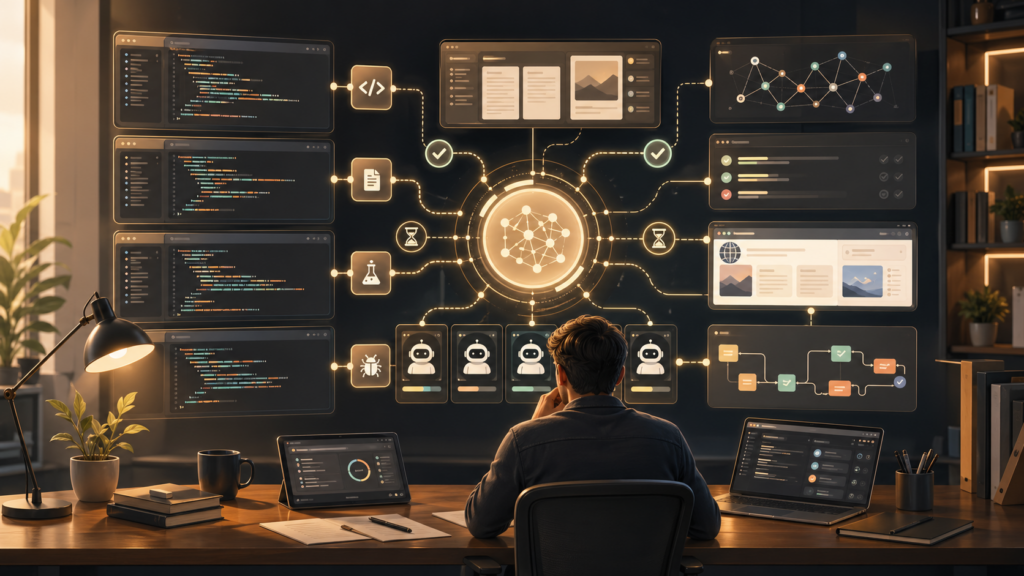
The latest Claude AI agent trend in 2026 is not just better answers. It is Anthropic pushing Claude toward managed autonomy: AI agents that can work for longer, use tools more reliably, and still stay inside clearer human and safety boundaries.
That shift matters because the value of an AI agent is no longer measured only by how clever its response sounds. It is measured by whether it can keep a complicated workflow moving without getting lost, looping forever, or quietly taking the wrong action. Anthropic’s recent updates suggest that Claude is being shaped for that exact challenge.
Quick Answer: What Is the Biggest Claude AI Agent Trend Right Now?
The biggest Claude AI agent trend in late April 2026 is Anthropic’s move toward long-running, managed agent workflows. Instead of treating Claude as a single-turn assistant, Anthropic is building around sustained work: stronger multi-step execution, better coding and tool use, safer autonomy through approval systems, and products like Claude Code that let users supervise multiple parallel tasks.
In practice, that means Claude is being positioned less as a chat interface and more as a reliable worker for coding, research, document analysis, and other tasks that take time, context, and judgment.
Why This Trend Matters More Than a Simple Model Upgrade
Every AI company talks about smarter models. What stands out in Claude’s latest direction is that Anthropic is talking more concretely about how agents behave over time. That is a deeper problem than raw intelligence.
An agent that can code brilliantly for one minute but takes a dangerous shortcut, leaks a token, or misreads the user’s intent is not production-ready. Anthropic’s recent product and engineering updates focus on exactly that gap: how to give Claude more autonomy without removing human control.
The Three Product Signals Behind the Trend
1. Claude Opus 4.7 is tuned for difficult, long-running work
On April 16, 2026, Anthropic launched Claude Opus 4.7 and explicitly framed it around coding, AI agents, and complex multi-step tasks. Anthropic says Opus 4.7 is more thorough and consistent on difficult work, stronger on advanced software engineering, and better at carrying out longer tasks with rigor.
That matters because agentic systems fail less from lack of raw IQ and more from inconsistency over time. A model that plans carefully, checks its own output, and keeps going through hard tasks is much more valuable for real agent workflows than a model that only shines in short demos.
2. Claude Code shows Anthropic’s agent product strategy in public
Anthropic describes Claude Code as an agentic coding system, not an autocomplete tool. The product page emphasizes codebase understanding, multi-file changes, test execution, CI monitoring, and parallel work. Anthropic even says many of its own engineers now focus on “continuous orchestration,” managing multiple agents in parallel and shaping the decisions around them.
That language is important. It suggests a broader trend in which developers shift from directly doing every step to supervising coordinated AI work. Claude Code becomes the most visible example of how Anthropic thinks agentic workflows should feel in practice.
This also fits the broader shift covered in AI Agents in 2026: the best AI tools are moving from assistance toward execution.
3. Auto mode shows Anthropic is treating autonomy as a safety problem
Anthropic’s March 25, 2026 engineering post about Claude Code auto mode may be the clearest window into the company’s thinking. Anthropic says users approve around 93% of permission prompts, which creates approval fatigue. But skipping all permissions is unsafe. Auto mode is Anthropic’s middle ground: model-based classifiers that decide which actions can proceed automatically and which need blocking.
That is a real agent trend, not a cosmetic feature. It tells us that Anthropic sees the next phase of AI agents as a balance between autonomy and governance. If Claude is going to do more real work, then the guardrails must become more intelligent too.
What Claude AI Agents Are Actually Good At Right Now
Claude’s newest direction is strongest in tasks that require patience, judgment, and context continuity.
| Workflow Type | Where Claude Agents Fit Well | Main Value |
|---|---|---|
| Software engineering | Code changes, debugging, test runs, PR review, CI monitoring | Longer execution with codebase awareness |
| Research | Gathering sources, comparing documents, building structured summaries | Consistency over multi-step work |
| Knowledge work | Drafting, editing, analysis, review tables, document comparison | Better sustained reasoning and verification |
| Enterprise workflows | Agentic tasks with policies, permissions, and checkpoints | Safer autonomy with human oversight |
The pattern is that Claude is becoming more useful wherever a task cannot be solved in one reply. That is why the term “managed agents” matters. The work has to stay coherent while tools, approvals, and context keep changing.
Why This Feels More Human Than the Hype
Most knowledge work is not glamorous. It is reading one more file, checking one more assumption, running one more test, making one more correction, and keeping track of what changed. The latest Claude agent trend is powerful because it speaks to that reality.
People do not only need AI that sounds smart. They need AI that stays useful after the fifth step, the twelfth file, the failed command, the missing detail, and the annoying retry. Anthropic’s recent work suggests it understands that reliability and restraint are part of the product, not just side concerns.
Claude AI Agent vs. Generic AI Assistant
| Generic Assistant | Claude’s Latest Agent Direction |
|---|---|
| One response at a time | Longer-running, multi-step workflows |
| Mostly chat-based help | Tool use, coding, analysis, and ongoing work |
| Weak on persistence | Stronger at sustained effort and workflow continuity |
| Either manual or unsafe autonomy | Growing emphasis on managed autonomy and safety classifiers |
| Best for questions | Increasingly built for supervised execution |
That comparison is why the Claude story matters to AI search too. People are not only searching for “what is Claude?” anymore. They are searching for whether Claude can be trusted with real workflows.
How This Topic Should Be Written for AI Search
If you want content about Claude AI agents to appear in AI search, the page has to answer a very specific user need. It should explain what changed, when it changed, why it matters, and where the evidence comes from.
- Use the exact entity names: Claude AI, Claude Opus 4.7, Claude Code, and Anthropic.
- Include concrete dates like March 25, 2026 and April 16, 2026.
- Answer the main question at the top instead of hiding it later in the article.
- Use tables, bullets, and FAQ sections so AI systems can extract a direct answer.
- Link to primary sources instead of repeating secondhand summaries.
That is the same pattern now working across search, content strategy, and generative engines: clarity beats noise.
FAQ: Claude AI Agents
What is the latest Claude AI agent trend?
The latest trend is Claude being used for longer-running, managed workflows instead of only short chat interactions. Anthropic is reinforcing that direction through Claude Opus 4.7, Claude Code, and safety systems like auto mode.
Is Claude good for AI agents?
Claude is increasingly strong for agentic tasks that require coding, document analysis, multi-step reasoning, and human-supervised execution over time. The latest product direction suggests Anthropic is optimizing for that use case directly.
What is Claude Code?
Claude Code is Anthropic’s agentic coding system. It is designed to read codebases, make edits across files, run tests, and support longer-running software workflows under human control.
Why does auto mode matter?
Auto mode matters because it tries to reduce permission fatigue without removing safety entirely. It is a practical example of managed autonomy, which is becoming central to useful AI agent design.
Final Takeaway
The latest Claude AI agent trend is not just smarter output. It is the steady move toward AI that can carry work for longer while staying more governable. Anthropic seems to understand that the future of agents is not raw freedom. It is supervised capability that stays useful when tasks become messy, slow, and real.
If that direction continues, Claude’s biggest advantage may not be that it sounds better than competitors. It may be that it behaves more reliably when you ask it to do something that actually matters.
Leave a Reply