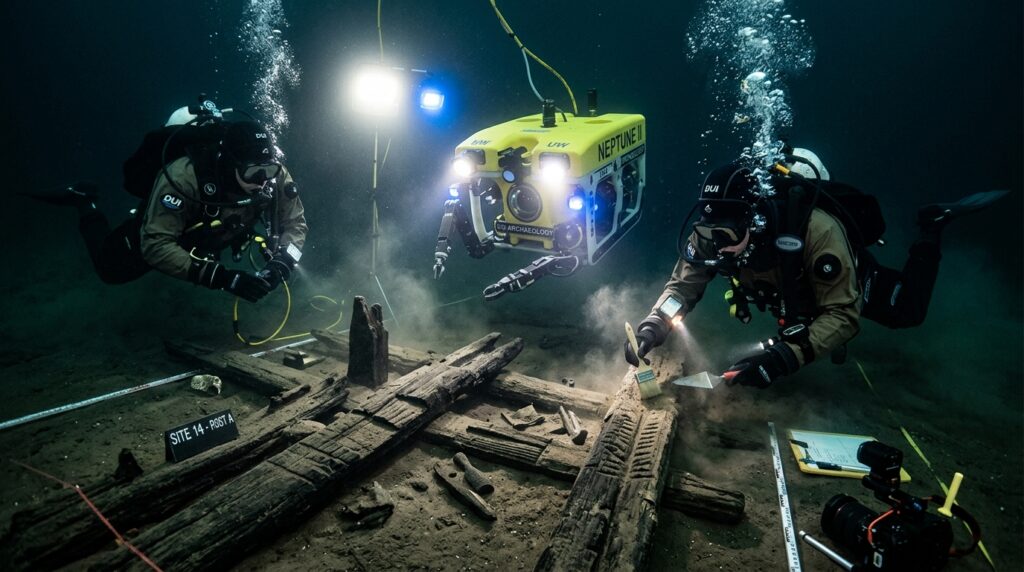
Twenty meters beneath the placid, mirror-like waters of Lake Arendsee in northern Germany, the beam of an underwater robotic submersible illuminated an anomaly half-buried in the silt. Protruding from the benthic mud was not a modern sunken artifact or a rotting waterlogged branch, but a 1.6-meter vertical post of ancient timber bearing unmistakable, rhythmic strike marks from stone adzes. Flanking it lay carefully split wooden boards stretching up to 1.3 meters in length. When radiocarbon analysis and stratigraphic dating yielded their verdict, the archaeological community was stunned: the timber is approximately 10,500 years old, placing its construction squarely in the Early Mesolithic era.
The discovery, announced in late September 2026 by the State Office for Heritage Management and Archaeology (LDA) Saxony-Anhalt in partnership with the Fraunhofer Institute for Optronics, System Technologies and Image Exploitation (IOSB-AST), strikes at the heart of our understanding of European prehistory. In orthodox archaeology textbooks, complex wooden architecture, post-in-ground load-bearing structures, and split-plank carpentry belong almost exclusively to the Neolithic Revolution—an epoch ushered in roughly 3,000 years later by immigrant farmers building massive longhouses. The submerged timbers of Arendsee prove that Europe’s post-Ice Age hunter-gatherers were already master carpenters, engineering durable lakeside architecture millennia before the first agricultural plow broke Central European soil.
The Geological Miracle: How a Collapsing Salt Dome Froze Time
In standard terrestrial archaeology, organic materials like wood, cordage, and skin rarely survive more than a few centuries. In the acidic, aerated soils of northern and central Europe, microbial activity, fungal mycelia, and fluctuating moisture cycles dissolve organic cellular walls with unforgiving efficiency. What makes Lake Arendsee, situated in the historic Altmark region, globally unique is a slow-motion geological drama playing out deep beneath its bed.
Unlike ordinary glacial kettle lakes that gradually silt up and become shallower over geological time, Lake Arendsee was formed—and continues to evolve—through the dissolution of a subterranean salt dome (a Zechstein salt diapir). Over thousands of years, subsurface groundwater leached the underlying Permian salt strata, creating vast subterranean voids. The overlying rock and sediment strata gradually subsided, causing the lake basin to continually sink deeper into the earth.
Gentle Subsidence vs. Cataclysm
Because the salt dissolution occurred gradually rather than in a sudden violent collapse, the ancient Early Holocene shoreline—along with the wooden settlements and docks built upon it—gently slipped downwards beneath the rising water table, preserving structural relationships intact without pulverizing them.
Anoxic Benthic Preservation
At 20 to 30 meters depth, the bottom water of Lake Arendsee is cold, permanently dark, and virtually devoid of dissolved oxygen. Sealed beneath a protective blanket of fine, oxygen-depleted sediment, the wood was completely shielded from wood-boring organisms and aerobic bacteria, effectively freezing cellular decomposition for 105 centuries.
The result is a preservation state so pristine that modern dendroarchaeologists can still trace the distinctive curvature of stone ax blows on the post’s tapered base, observing where ancient artisans deliberately trimmed the trunk to anchor it into prehistoric ground.
KEY FINDINGS: THE LAKE ARENDSEE MESOLITHIC REVELATION
- 10,500-Year Antiquity: Radiocarbon dating places the worked timber at c. 8,500 BCE, deep within the Early Mesolithic (Preboreal/Boreal transition).
- Engineered Structural Components: Includes a 1.6-meter trimmed vertical post with working scars and deliberately split wooden boards measuring up to 1.3 meters in length.
- 3,000-Year Architectural Leap: Predates the arrival of Central Europe’s Linear Pottery Culture (LBK) farming longhouses by three full millennia.
- Fraunhofer Robotic Survey: Located and documented using autonomous underwater vehicles (AUVs), high-frequency multibeam sonar, and ROV 3D photogrammetry.
- Geological Salt-Sink Time Capsule: Preserved by the subsidence of a subterranean Zechstein salt dome that pulled the ancient shoreline 20 meters below into an anoxic cold water basin.
High-Tech Marine Archaeology: Sonar Swarms and Submersible Eyes
Locating prehistoric timber 20 meters underwater in a murky inland lake requires technology far beyond traditional diving methods. The expedition represents a landmark collaboration between cultural heritage authorities and advanced robotics engineers from Fraunhofer IOSB-AST (Applied Systems Technology) in Ilmenau.
Using a combination of multibeam bathymetric sonar mounted on autonomous surface vessels and compact remotely operated vehicles (ROVs) equipped with polarized optical sensors, the team generated millimeter-resolution 3D acoustic models of the lake’s subterranean terraces. Anomalies reflecting acoustic profiles characteristic of waterlogged deciduous hardwoods were flagged for diver ground-truthing.
“Finding organic wood of this antiquity in Central Europe is like discovering a book written in an unknown language whose pages have remained completely unburned,” stated lead researchers from the State Office for Heritage Management and Archaeology Saxony-Anhalt. “The technological marriage between robotic sonar mapping and scientific deep diving has allowed us to locate an entire submerged prehistoric landscape that had been lost for ten millennia.”
Scientific divers trained in underwater geoarchaeology carefully excavated test trenches around the timber using low-pressure sediment water dredges. The retrieved boards and post were stabilized immediately upon surfacing in specialized water baths to prevent rapid desiccation, warping, and cell collapse before being transported to conservation laboratories in Halle.
Shattering the “Simple Forager” Myth: Stone Age Engineering
Why does the discovery of a wooden post and a few planks fundamentally disrupt archaeological dogma? The answer lies in how human socio-technological evolution has historically been categorized.
Under conventional frameworks, the European Mesolithic (roughly 9,600 to 5,500 BCE) was viewed as a transitional twilight between the mammoth-hunting Upper Paleolithic and the agricultural Neolithic. Mesolithic hunter-gatherer bands were long assumed to be strictly mobile, small-scale foragers living in ephemeral shelters made of bent saplings, reeds, and animal hides—leaving behind little in the archaeological record beyond microlithic flint arrowheads, campfire charcoal, and hazelnut shells.
True carpentry—the felling of massive hardwood trunks, splitting logs into uniform planks along the grain using wedges, and constructing durable post-in-ground timber framing—was considered a signature innovation of the incoming Neolithic farmers who built the famed 30-meter-long LBK timber houses.
Lake Arendsee shatters that dichotomy. The recovered artifacts demonstrate:
- Advanced Timber Selection and Forestry: Early Holocene foragers deliberately selected straight-grained trunks, likely oak or pine, possessing specific mechanical properties suited for structural loads.
- Radial Trunk Splitting: The split boards confirm that Mesolithic artisans understood controlled wedge splitting, cleaving round logs into flat architectural boards using antler, bone, or ground stone wedges.
- Semi-Sedentary Wetland Infrastructure: Constructing permanent or semi-permanent shoreline architecture—whether elevated stilt huts, seasonal fishing platforms, or water-spanning walkways—demanded substantial labor investment, pointing toward organized, semi-sedentary communities exploiting rich aquatic ecosystems.
Comparative Chronology: Prehistoric Timber Across Europe
To contextualize where the Lake Arendsee discovery sits within Europe’s archaeological timeline, consider how it compares against the most significant prehistoric wooden discoveries on the continent:
| Site / Culture | Approximate Date | Location | Wood Technology & Structures | Cultural Context |
|---|---|---|---|---|
| Star Carr | ~9,000–8,500 BCE | North Yorkshire, UK | Hewn timber platforms, split aspen trackways | Early Mesolithic hunter-gatherers |
| Lake Arendsee | ~8,500 BCE (10,500 BP) | Saxony-Anhalt, Germany | 1.6m structural post, dressed split planks at 20m depth | Early Mesolithic engineered lake architecture |
| Tybrind Vig | ~5,000–4,000 BCE | Fyn, Denmark | Submerged dugout canoes, decorated ash paddles | Late Mesolithic Ertebølle culture |
| Linear Pottery (LBK) | ~5,500–4,900 BCE | Central Europe | Monumental oak longhouses, timber water wells | Early Neolithic agricultural pioneers |
| Alpine Pile Dwellings | ~4,300–800 BCE | Circum-Alpine lakes | Extensive stilt villages, elevated timber floors | Neolithic to Bronze Age lake communities |
Dendrochronology, Ancient eDNA, and the Future of Submerged Landscapes
The recovery of the timbers is merely the prologue of an intensive scientific investigation. At the laboratories of the State Office for Heritage Management and Archaeology in Halle, specialists are conducting high-precision analyses:
- Dendrochronological Tree-Ring Matching: Researchers are examining the growth rings of the timber to anchor it into floating or continuous European prehistoric tree-ring chronologies, which can pinpoint the exact felling season down to the year.
- 3D Micro-CT Kinematic Tool Analysis: High-resolution micro-computed tomography of the cut marks will reconstruct the precise geometry and material of the stone adzes used, shedding light on the woodworking tools of Early Holocene Germany.
- Sedimentary Ancient DNA (sedaDNA): Core samples extracted directly from the sediment layers sealing the timbers are being sequenced to reconstruct the local micro-ecosystem—revealing the fish species harvested, ancient tree species, and even genetic traces of the prehistoric humans who inhabited the lakeshore.
As climate change, lowering water tables, and advanced underwater robotics continue to unlock previously inaccessible subterranean and subaquatic environments, Europe’s sunken lakes are emerging as revolutionary archives. The ancient timbers of Lake Arendsee remind us that human ingenuity did not suddenly begin with the domestication of grain or the erection of stone monuments; ten thousand years ago, beside the sinking salt lakes of the European wilderness, Stone Age architects were already shaping the world with timber, skill, and bold imagination.