For nearly two centuries, the solitary written essay has stood as the unchallenged gold standard of higher education. From Ivy League seminar rooms to massive undergraduate lecture halls, the formula remained immutable: assign a complex prompt, send students home for three weeks of research, and evaluate the submitted prose as a direct proxy for intellectual competence. Today, that entire paradigm has officially reached its expiration date.
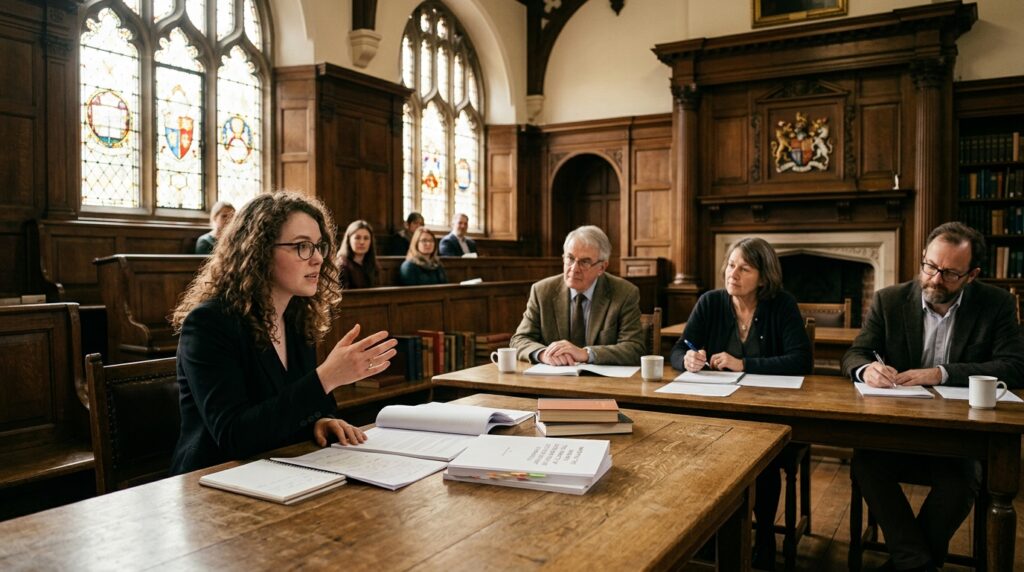
As universities across North America, Europe, and Asia open their Fall 2026 academic semesters, faculty syllabi reveal an unmistakable pedagogical revolution. Confronted by advanced reasoning models and autonomous agentic workflows capable of generating publication-grade academic prose in minutes, universities have abandoned the futile arms race of AI detection software. Instead, higher education is staging a dramatic return to its deepest medieval roots: the viva voce—the rigorous, face-to-face oral defense.
The Epistemic Collapse of the Take-Home Paper
The demise of the take-home essay was not caused by a sudden lack of student integrity; it was precipitated by an epistemic collapse. Throughout 2024 and 2025, institutions poured millions into automated algorithmic detectors that promised to distinguish machine-generated text from human syntax. The results were catastrophic: rampant false positives that unjustly penalized non-native English speakers, alongside trivially simple prompt-chaining techniques that allowed synthetic essays to glide past every commercial filter undetected.
By mid-2026, academic consensus had crystallized around a stark reality: the presence of eloquent written prose no longer proves the presence of human thought. When an autonomous agent can synthesize fifty academic journal articles, cross-reference historical counter-arguments, and format citations in flawless Chicago style in under sixty seconds, judging a student solely by their final written artifact is educational malpractice.
“We spent two years trying to police the machine. We finally realized that the text on the page is no longer an authentic window into a student’s mind. If you want to know what a student understands, you must strip away the digital interface and ask them to defend their ideas aloud.”
— Dr. Alistair Finch, Dean of Humanities, Oxford-Cambridge Academic Consortium
This realization has forced institutions to acknowledge a fundamental truth: written text has become too cheap to serve as the currency of intellectual evaluation.
Back to Bologna: The 800-Year History of the ‘Living Voice’
While the sudden resurgence of oral examinations may feel radical in modern collegiate environments, it is, in historical terms, a return to normalcy. From the founding of the University of Bologna in 1088 through the Renaissance academies of Paris, Oxford, and Padua, academic assessment was exclusively oral.
Degrees were not awarded for submitting stacks of parchment; they were conferred after the candidate withstood the disputatio—a public scholastic disputation in which students defended formal theses against blistering counter-arguments posed by their professors and peers. Assessment was conducted viva voce (literally, “with living voice”).
The transition toward standardized written testing and take-home term papers only gained dominance during the Industrial Era. As university enrollments exploded in the late 19th and 20th centuries, oral examinations became an administrative impossibility. Written papers offered an efficient, scalable mechanism for a single professor to process hundreds of students simultaneously. For a century, this industrial compromise functioned adequately. But generative AI has broken the economic equation: producing text is now instantaneous, while verifying human comprehension requires genuine, synchronous engagement.
The ‘Two-Lane’ Assessment Architecture
Leading research institutions—including the University of Pennsylvania, Cornell, and the University of Sydney—are spearheading what educational theorists describe as the Two-Lane Assessment Model for Fall 2026:
- Lane 1 (The Open-Canvas Exploratory Sandbox): Students are actively encouraged to collaborate with frontier AI systems to conduct literature reviews, generate exploratory code, synthesize disparate datasets, and organize macro-level arguments. Here, AI literacy is embraced as an essential modern skill.
- Lane 2 (The Socratic Defense Gate): The submitted project merely qualifies the student for assessment; the grade itself is determined in a 10- to 20-minute structured oral defense. In this chamber, the student has no screens, no earpieces, and no generated notes. They must stand before a panel or instructor and articulate their methodology from the ground up.
In a viva voce setting, the superficial polish of an AI-crafted paper evaporates within two minutes of Socratic interrogation. Examiners do not ask students to recite facts; they probe the fragile connective tissue of their logic:
- “On page four, you chose to discard the econometric model favored by Autor in favor of a non-linear regression. Walk us through why you made that specific tradeoff.”
- “If we were to alter the foundational premise of your third thesis—suppose interest rates remained elevated for another decade—how does your conclusion collapse or adapt?”
- “Can you articulate the strongest counter-argument to the position you took in section two, and why did you find it insufficient?”
A student who relied on a chatbot to write their paper inevitably falters. They cannot explain why a specific sentence exists, why an alternative hypothesis was rejected, or how adjacent conceptual frameworks interact. Conversely, a student who genuinely conducted the intellectual labor speaks with spontaneous conviction, nuance, and contextual agility.
The Cognitive Neuroscience of Spontaneous Articulation
Why is the spoken word so impervious to artificial deception? Cognitive neuroscientists point to the profound neurological divergence between passive text editing and spontaneous verbal retrieval.
When a human being is forced to speak extemporaneously about a subject, their brain activates the dorsolateral prefrontal cortex, Broca’s area, and the hippocampus in a dense, rapid-fire feedback loop. Spoken dialogue requires instantaneous working-memory manipulation: the speaker must access semantic networks, retrieve stored schemas, synthesize abstract concepts, monitor their listener’s non-verbal feedback, and formulate grammatical structures simultaneously.
This cognitive symphony cannot be faked. In educational psychology, this phenomenon is known as epistemic ownership. When a learner has wrestled through the messy, frustrating phases of authentic research—the discarded drafts, the false starts, the conceptual roadblocks—the knowledge is deeply etched into their neurobiology. Spoken language serves as a direct diagnostic probe of whether a neural schema truly exists or whether it was outsourced to an external server.
Addressing the Scalability and Equity Paradox
Despite its pedagogical superiority, the widespread revival of the viva voce introduces formidable operational and psychological challenges that universities are now scrambling to resolve:
- Faculty Bandwidth and Scalability: In a seminar of 15 graduate students, oral defenses are intimate and enlightening. In an introductory macroeconomics course with 600 undergraduates, conducting 600 fifteen-minute interviews demands 150 hours of intensive faculty labor—a staggering burden that risks burning out adjunct instructors and teaching assistants.
- Performance Anxiety and Neurodiversity: For students with speech impediments, extreme social anxiety disorders, or neurodivergent processing profiles, face-to-face cross-examinations can trigger severe autonomic stress responses that suppress cognitive retrieval. A high-stakes verbal grill is not an accurate measurement of an autistic student’s mathematical brilliance or a shy writer’s poetic depth.
- Linguistic Equity for International Scholars: At global universities where significant portions of the student body are non-native English speakers, oral assessments can conflate verbal fluency with conceptual comprehension. A brilliant conceptual analysis may stumble under the pressure of real-time foreign-language grammar.
To mitigate these inequities, forward-thinking departments are introducing tiered accommodations: providing the defense questions in advance, offering low-stakes formative practice sessions, allowing written whiteboarding during the defense, and developing hybrid formats where students can respond using structured handwritten diagrams alongside speech.
The Next Frontier: AI as the Socratic Sparring Partner
The irony of the current moment is that artificial intelligence, having shattered the take-home essay, is now being enlisted to make the revival of oral examinations scalable. Across several pilot programs this semester, universities are experimenting with voice-enabled AI sparring partners.
Instead of relying solely on scarce human faculty hours, students participate in interactive 30-minute voice-to-voice Socratic dialogues with specialized institutional AI agents before their final exam. The AI acts not as a cheat sheet, but as an aggressive intellectual adversary—challenging the student’s assumptions, forcing them to clarify definitions, and flagging logical inconsistencies in their verbal arguments.
By the time the student steps into the physical examination hall with their human professors, they have already refined their oral reasoning against a tireless digital Socratic interlocutor. The technology that threatened to atrophy human cognition is repurposed into the whetstone that sharpens it.
The Humanist Renaissance in Modern Learning
The death of the homework essay is not an educational tragedy; it is an overdue liberation. For decades, the modern academy drifted toward a transactional model of education, where learning was reduced to the production of static documents traded for credentials.
By compelling universities to abandon written artifacts in favor of spontaneous, live human dialogue, generative AI has inadvertently triggered a humanist renaissance. It has reminded educators that true intelligence is not measured by the smoothness of an output, but by the agility, humility, and conviction of a thinking mind. In an age of infinite synthetic eloquence, knowledge only becomes real when it is spoken.