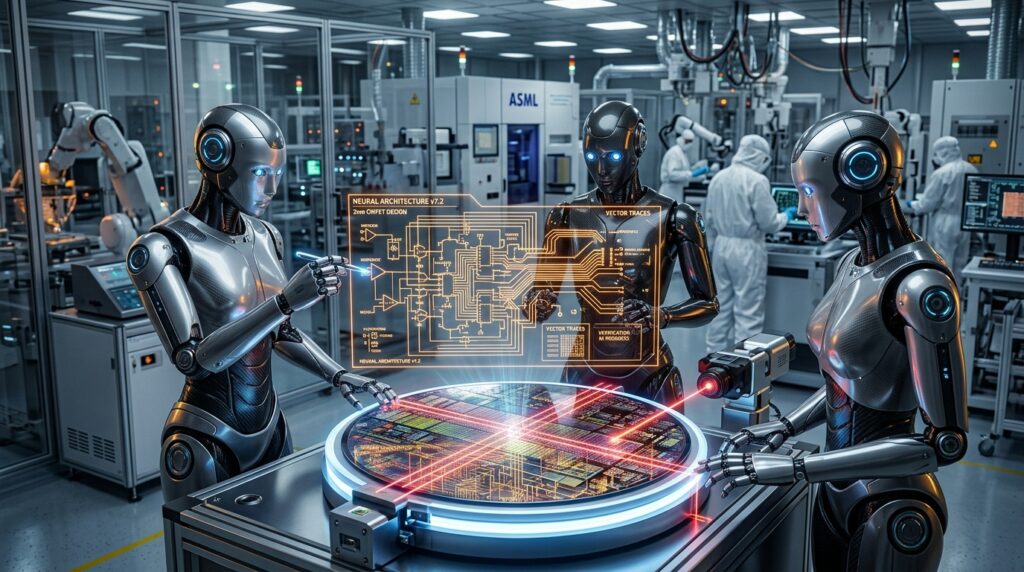
For more than half a century, the unrelenting cadence of Moore’s Law was governed by a quiet, mounting paradox: while the density of microelectronics doubled every two years, the human cognitive capacity required to design them remained strictly linear. Today’s leading-edge systems-on-chip (SoCs) pack over 100 billion transistors onto a sliver of silicon no larger than a postage stamp, requiring sprawling engineering armies, multi-million-line RTL codebases, and grueling three-year development cycles. But this week, the semiconductor industry crossed an irreversible historical inflection point. With the unveiling of the Synopsys Autopilot Platform, its AgentEngineer portfolio, and an unprecedented multi-year alliance with OpenAI to build GPT-Synopsys, the era of autonomous silicon engineering has officially arrived.
The announcement from Synopsys—the global titan powering more than a third of worldwide electronic design automation (EDA)—marks the formal advent of what the industry terms Level 5 EDA Autonomy. Unlike passive code completion tools or isolated algorithmic tuners, AgentEngineer deploys swarms of domain-specific, long-horizon AI agents capable of planning, executing, and iteratively verifying complex chip design workflows from initial architectural RTL down to sign-off and photolithography masks. Simultaneously, semiconductor rival AMD unleashed Ross, an agentic engineering assistant operating over the open Model Context Protocol (MCP) that condensed a multi-day FPGA synthesis and implementation cycle into just two hours.
With over 50 top-tier customer engagements underway—including industry heavyweights NVIDIA, Intel, and Samsung—the implications reach far beyond engineering convenience. We are witnessing the birth of a closed-loop, recursive silicon flywheel: artificial intelligence is now designing the very compute engines required to train the next generation of frontier intelligence.
The Cognitive Wall: Why Traditional Chip Design Reached Its Limit
To understand why the semiconductor industry is staking its future on autonomous agents, one must appreciate the staggering complexity of sub-2-nanometer manufacturing. At the atomic frontier—where transistors are constructed from nanosheet gate-all-around (GAA) architectures and interconnected by Angstrom-scale copper wiring—classical design rules cease to behave predictably.
Modern microchip creation is divided into an intricate gauntlet of interdependent disciplines:
- RTL Architecture & Logic Synthesis: Translating algorithmic concepts into register-transfer level hardware description code (SystemVerilog/VHDL).
- Floorplanning, Placement & Routing (P&R): Arranging billions of microscopic cells and billions of interconnected wires without causing electro-migration or intolerable signal delays.
- Power, Performance, and Area (PPA) Optimization: Navigating an astronomical multi-objective parameter space where optimizing clock frequency by 2% can cause thermal runaway or spike leakage currents.
- Design for Manufacturing (DFM) & Physical Sign-Off: Ensuring that complex optical proximity corrections (OPC) and extreme ultraviolet (EUV) lithography masks will yield functional dies in TSMC, Intel, or Samsung wafer fabs.
“Human engineering teams can no longer mentally hold the combinatorial explosion of modern silicon,” remarked an EDA systems architect during the Autopilot launch. “We are operating in state spaces with $10^{100}$ possible placement configurations. For humans, finding the Pareto-optimal PPA frontier is like searching for a grain of sand across an entire galaxy. For autonomous multi-agent systems, it is an exhaustive, parallelized optimization surface.”
Historically, the biggest bottleneck in this pipeline has not been physical placement, but verification closure. Semiconductor teams routinely expend up to 70% of total engineering hours merely writing testbenches, running randomized fault simulations, and hunting corner-case bugs. A single undiscovered logic flaw can corrupt an entire silicon tapeout, costing upwards of $500 million in lost photomask tooling and delaying product roadmaps by a full year. Autonomous agents are transforming this defensive slog into an aggressive, automated science.
Legacy EDA: Fragmented Human Slog
In conventional workflows, senior engineers manually script isolated point tools, inspect log files spanning millions of lines, manually tweak timing constraints, and spend months attempting to close timing slack or eliminate DRC (design rule check) violations. Communication between RTL designers, analog teams, and packaging specialists is fragmented and slow.
Level 5 Agentic EDA: Autonomous Swarms
Domain-specific agents continuously reason, formulate physical layout hypotheses, launch parallel simulator instances, inspect intermediate waveforms, and self-correct across the full toolchain. Design objectives are specified via high-level constraints, while agents orchestrate execution across verification, AMS design, and thermal analysis with zero latency.
AT A GLANCE: THE AUTONOMOUS SILICON DESIGN REVOLUTION
- Flagship Initiative: Synopsys Autopilot™ Platform featuring the AgentEngineer™ suite of seven domain-specific engineering agents.
- OpenAI Collaboration: Multi-year strategic partnership to build GPT-Synopsys, a specialized frontier reasoning model equipped with EDA grammar, Verilog AST parsing, and direct toolchain actuation.
- Autonomy Classification: Categorized as Level 5 on the industrial autonomy scale—independent multi-stage execution within human-defined guardrails and policy gates.
- AMD’s MCP Counterpart: AMD announced Ross, an agentic AI assistant utilizing the Model Context Protocol (MCP) to automate Vivado and Vitis toolchains, reducing FPGA design cycles from 48 hours to 2 hours.
- Measured Performance Gains: Up to 30% overall design productivity improvement and up to 50x faster verification closure across production engagements.
- Tier-1 Early Adopters: Over 50 commercial engagements across global chipmakers including NVIDIA, Intel, and Samsung Electronics.
- Strategic Consequence: Establishes a recursive hardware-software self-improvement loop where AI agents design custom silicon accelerators to train next-generation AI models.
The Seven Agents of AgentEngineer: Orchestrating the Silicon Stack
Synopsys’ breakthrough does not rely on a monolithic, one-size-fits-all chatbot. Instead, AgentEngineer deploys a federated collective of seven specialized, long-horizon agents, each trained on decades of proprietary chip design heuristics, synthesis algorithms, and physics simulators:
- The Verification Agent: Automatically generates complex SystemVerilog Universal Verification Methodology (UVM) environments, formulates directed test sequences for obscure corner cases, analyzes code and functional coverage, and iteratively refines assertions until achieving 100% verification closure.
- The Physical Implementation Agent: Directs autonomous macro placement, power grid synthesis, clock tree synthesis (CTS), and multi-layer routing, using reinforcement learning to avoid thermal hotspots and signal crosstalk.
- The Analog/Mixed-Signal (AMS) Agent: Tackles the notoriously intuitive domain of analog design—automatically sizing operational amplifiers, balancing differential pairs, and optimizing phase-locked loops (PLLs) under strict process-voltage-temperature (PVT) variations.
- The Timing Closure Agent: Performs continuous static timing analysis (STA), identifying critical setup and hold violations, autonomously inserting buffer trees, and conducting cell-sizing adjustments to eliminate negative slack.
- The PPA Optimization Agent: Dynamically balances trade-offs between dynamic power, static leakage, silicon area, and target gigahertz frequencies, discovering non-intuitive transistor arrangements that human teams would never consider.
- The DFM & Lithography Agent: Simulates electron-beam and optical lithography phenomena at the foundry interface, pre-correcting sub-wavelength diffraction anomalies before sending masks to manufacturing.
- The System Validation Agent: Emulates full hardware-software co-design, booting bare-metal firmware and operating system kernels on virtual emulators weeks before physical silicon arrives from the foundry.
Crucially, these agents do not operate in silos. If the Timing Closure Agent discovers an irreconcilable delay along a critical arithmetic datapath, it does not simply fail; it communicates back to the RTL Architecture Agent to propose a pipeline stage refactoring, updates the Verification Agent with new test assertions, and re-triggers synthesis—all before a human engineer opens their morning dashboard.
The Engine Under the Hood: GPT-Synopsys and the Model Context Protocol
Why did this breakthrough occur now, in late 2026, rather than years earlier? The answer lies in the structural maturation of agentic reasoning architectures and standardized tool interfaces.
Historically, when researchers attempted to point generic large language models at hardware design, the results were underwhelming. LLMs frequently hallucinated invalid Verilog syntax, produced non-synthesizable constructs, and had no native awareness of physical parasitic capacitance or clock skews. The partnership between Synopsys and OpenAI addresses this by training GPT-Synopsys directly on billions of tokens of verified RTL, timing reports, SDC (Synopsys Design Constraints), and synthesis netlists.
Moreover, the integration relies on structured protocols such as Anthropic’s Model Context Protocol (MCP), which AMD leveraged extensively for its Ross assistant. Rather than relying on fragile shell scraping or terminal piping, agents query EDA engines through standardized, schema-validated tool interfaces:
- Bidirectional Telemetry: Agents stream live simulation telemetry, waveform VCD dumps, and congestion heatmaps directly into their active reasoning windows.
- Deterministic Rollbacks: If an agent’s placement optimization degrades timing slack, the EDA runtime performs an atomic rollback to the previous checkpoint, enabling safe exploratory trial-and-error.
- Strict Policy Guardrails: Engineering leaders define explicit hard constraints (e.g., maximum power budgets of 350 Watts, die area ceilings of 600 mm², or strict design rule tolerances) that no agent can violate.
The Recursive Singularity: AI Building the Hardware of Its Own Future
While the immediate financial return for semiconductor firms is immense—condensing nine-month engineering sprints into mere weeks and unlocking billions in operational savings—the broader macro implication is dizzying: AI has entered a recursive hardware self-improvement loop.
For the past four years, frontier AI models have expanded exponentially in capability, but their evolution has been gated by the physical availability of compute: GPU clusters running at the edge of power substation capacity, thermal throttling in high-density data centers, and the grueling multi-year lag required to design custom AI accelerators (TPUs, NPUs, and neuromorphic engines).
With Level 5 EDA autonomy, that hardware bottleneck is dissolving. Frontier reasoning models can now design hyper-specialized systolic arrays, customize sparse matrix multipliers, and optimize photonic-electronic hybrid dies tailored specifically to the mathematical operations of next-generation transformer and diffusion architectures. Once fabricated, these customized accelerators provide the compute muscle to train even more capable foundation models—which will, in turn, design even more efficient 1.4-nanometer silicon architectures.
As the Synopsys Autopilot platform heads toward general commercial release at the end of 2026, the electronics industry has crossed a profound threshold. The silicon that powers the modern world is no longer drawn solely by human hands; it is dreamed, routed, and perfected by the very machine intelligence it was born to support.