For more than a century, clinical medicine has approached human aging with an unwritten assumption of inevitability: tissues inevitably degrade, genetic integrity erodes, and cellular decline can at best be managed, mitigated, or slowed. But this week at the Eyecelerator conference during the American Academy of Ophthalmology (AAO) annual meeting in New Orleans, that therapeutic dogma faces its most profound scientific challenge yet. Researchers are unveiling the inaugural human clinical data from the world’s first trial of partial epigenetic reprogramming—a biological intervention engineered not to treat symptoms, but to actively turn back the biological clock of human cells.
The therapy, designated ER-100 and developed by Boston-based biotech pioneer Life Biosciences, represents the culmination of nearly two decades of cellular biology. Administered as a single intravitreal injection in patients suffering from blinding optic neuropathies—specifically primary open-angle glaucoma (OAG) and non-arteritic anterior ischemic optic neuropathy (NAION)—ER-100 delivers genetic instructions designed to strip away accumulated molecular age markers from damaged retinal ganglion cells, restoring their transcriptional patterns to a pristine, youthful state.
Following landmark FDA clearance earlier this year and the dosing of the first human cohort in June 2026 (Phase 1 clinical trial NCT07290244), the presentation led by Chief Scientific Officer Dr. Sharon Rosenzweig-Lipson marks a historic transition: cellular age reversal has officially crossed the threshold from speculative laboratory rodent models into living human patients.
The Information Theory of Aging: Why Cells Forget Who They Are
To grasp the revolutionary nature of ER-100, one must first reconsider what biological aging actually is. For decades, the dominant paradigm held that aging is primarily driven by accumulated DNA damage—irreversible mutations, double-strand breaks, and genetic errors that slowly corrupt the cellular blueprint until organ systems collapse.
However, recent discoveries spearheaded by Harvard Medical School geneticist Dr. David Sinclair and leading epigenetics researchers suggest an entirely different mechanism known as the Information Theory of Aging. In this framework, the cellular hardware (the DNA sequence) remains remarkably intact throughout an individual’s lifetime. What degrades is the software: the epigenome.
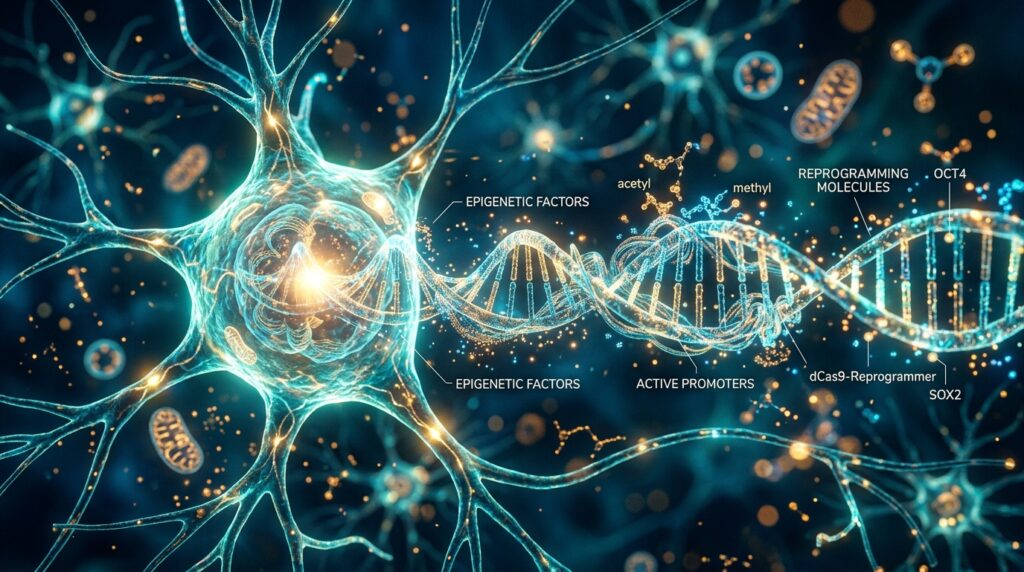
The epigenome is the complex molecular apparatus—composed of methyl groups, histone modifications, and chromatin scaffolding—that dictates which genes are turned on and which are silenced. A neuron and a skin cell possess the exact same genomic sequence; their stark differences in structure and function are governed entirely by epigenetic programming. Over decades of environmental stress, oxidative damage, and cellular replication, these epigenetic marks accumulate noise. Chromatin unravels, methyl groups detach or misplace, and genes that should remain silent begin to leak transcription.
“Aging is not the loss of the genetic digital code, but the accumulation of analog scratches on the compact disc,” explains Dr. David Sinclair. “The information required to operate a youthful, perfectly functioning cell is never truly lost. It is simply obscured by epigenetic noise. If you polish the surface of the disc, the original code can be read cleanly once again.”
In conditions like glaucoma and ischemic optic neuropathy, this epigenetic decay renders retinal ganglion cells incapable of repairing axonal damage or sustaining synaptic transmission. ER-100 operates on the premise that if you can wipe away that epigenetic noise, the retinal cells will spontaneously recover their endogenous regenerative vigor.
Conventional Gene Therapy: Single-Target Correction
Traditional gene augmentation therapies (such as Luxturna for retinal dystrophy) function by introducing a functional copy of a single mutated gene, or by inhibiting a specific downstream inflammatory protein. While clinically powerful, they operate strictly within the bounds of disease management: they cannot restore damaged cellular architecture, reverse mitochondrial exhaustion, or rejuvenate tissue that has lost its regenerative potential.
Epigenetic Restoration: Systemic Youthful Reset
Partial epigenetic reprogramming does not modify DNA sequences or target isolated enzymatic pathways. Instead, it deploys master transcription factors that recalibrate thousands of gene networks simultaneously. By activating endogenous chromatin remodeling complexes, the cell resets its metabolic state, clears toxic protein aggregates, restores mitochondrial respiration, and reactivates dormant neuroregenerative pathways.
AT A GLANCE: LIFE BIOSCIENCES’ ER-100 TRIAL
- Clinical Trial Identification: Phase 1 first-in-human trial (NCT07290244), evaluating safety, tolerability, and visual function in patients aged 40 to 85.
- Target Pathology: Primary open-angle glaucoma (OAG) and non-arteritic anterior ischemic optic neuropathy (NAION), major causes of irreversible blindness worldwide.
- The OSK Factor Trio: Delivers OCT4, SOX2, and KLF4 via an adeno-associated virus (AAV) vector, intentionally omitting the oncogenic factor c-Myc to preserve somatic identity.
- The Tet-On Safety Switch: Transcription is governed by an oral doxycycline-inducible promoter, allowing clinicians to switch the reprogramming factors on for an 8-week pulse and immediately deactivate them.
- Mechanism of Action: Recruits TET1 and TET2 methylcytosine dioxygenases to reverse DNA methylation age without causing pluripotency dedifferentiation or teratoma formation.
- Broader Pipeline: Beyond ophthalmology, preclinical validation is advancing across metabolic dysfunction-associated steatohepatitis (MASH) and systemic tissue aging.
The Yamanaka Revolution Refined: How OSK Evades the Cancer Trap
The foundational science of cellular reprogramming dates back to 2006, when Japanese stem cell researcher Shinya Yamanaka made the Nobel Prize-winning discovery that introducing four specific transcription factors—Oct3/4, Sox2, Klf4, and c-Myc (OSKM)—could rewind adult differentiated cells back into embryonic-like induced pluripotent stem cells (iPSCs).
However, early attempts to translate Yamanaka factors into living organisms proved disastrous. When continuously expressed in living animals, the full OSKM cocktail stripped away cellular identity entirely. Skin cells forgot they were skin, liver cells forgot they were liver, and unchecked proliferation rapidly induced lethal tumors known as teratomas. Furthermore, the inclusion of c-Myc, a potent oncogene, created severe cancer risks.
The breakthrough that made ER-100 clinically viable came when researchers discovered two crucial modifications:
- Omitting c-Myc: By delivering only three factors—Oct4, Sox2, and Klf4 (OSK)—the therapeutic payload retains the capacity to erase epigenetic aging marks while drastically reducing the risk of neoplastic transformation.
- Partial, Pulsed Reprogramming: Rather than allowing continuous expression, OSK factors are expressed only temporarily. This controlled pulse triggers cellular rejuvenation without pushing the cell past the epigenetic barrier into pluripotency. The retinal ganglion cell remains unequivocally a retinal neuron—it simply functions like a neuron that is decades younger.
At the biochemical level, OSK expression recruits endogenous demethylating enzymes, specifically TET1 and TET2 (ten-eleven translocation methylcytosine dioxygenases). These molecular scissors recognize age-related hypermethylation patterns on CpG islands across the genome, excising methyl groups and restoring youthful chromatin accessibility. In seminal preclinical studies published in Nature, destroying the genes for TET1 and TET2 completely abolished the rejuvenation effect, proving that active DNA demethylation is the indispensable engine of cellular age reversal.
The Precision Architecture: AAV Delivery and the Doxycycline Switch
Delivering gene therapies into the fragile microenvironment of the human eye requires exceptional precision. ER-100 accomplishes this through a dual-component engineering system that balances therapeutic efficacy with rigorous pharmacological control.
The vector consists of a bioengineered adeno-associated virus (AAV) capsid optimized for high-affinity transduction of mammalian retinal ganglion cells following a standard, minimally invasive intravitreal injection. Once inside the target neurons, however, the therapeutic OSK genes remain entirely dormant.
Expression is controlled via an integrated Tet-On regulatory promoter. To initiate cellular reprogramming, patients are prescribed an oral course of the well-tolerated antibiotic doxycycline. The antibiotic acts as a chemical key: binding to a reverse tetracycline-controlled transactivator, it initiates transcription of the OSK factors. In the Phase 1 trial protocol, the treatment is maintained for a strictly monitored eight-week therapeutic window.
This pharmacological switch provides an essential safeguard against over-reprogramming. If clinical monitoring detects any aberrant cellular behavior, elevated intraocular pressure, or unexpected off-target effects, physicians can simply discontinue the oral doxycycline. Within hours, OSK transcription ceases completely, returning the vector to an inert baseline.
Why the Eye? The Retina as the Proving Ground for Neurology
Life Biosciences’ deliberate choice of ophthalmology as the first clinical frontier is strategically brilliant from both a biological and regulatory perspective. The human eye is an anatomically compartmentalized, immune-privileged organ, meaning systemic immune responses against the viral capsid or transcription factors are substantially attenuated compared to intravenous gene therapies.
Furthermore, retinal ganglion cells (RGCs) are central nervous system neurons. In mature mammals, RGC axons cannot regenerate after injury or age-related degeneration. When intraocular pressure damages optic nerve fibers in glaucoma patients, or when ischemic events cut off blood flow in NAION, the resulting vision loss has historically been considered permanent. Restoring visual function in an optic neuropathy model cannot be attributed to a placebo effect; it requires verifiable neuroregeneration and electrophysiological signaling recovery.
In non-human primate studies preceding the Phase 1 trial, Life Biosciences demonstrated that OSK therapy promoted robust axon regeneration through the optic nerve crush site, accompanied by a statistically significant restoration of pattern electroretinogram (pERG) amplitudes—the gold-standard electrophysiological measurement of retinal ganglion cell function. If the Phase 1 interim data presented at AAO 2026 mirrors these preclinical signals, it will provide the first clinical proof that damaged human central nervous system pathways can be coaxed into functional regeneration.
The Horizon: From Vision Loss to Systemic Gerotherapeutics
While the immediate clinical objective of ER-100 is rescuing vision for millions of patients suffering from glaucoma and NAION, the implications of this trial reverberate across the entirety of medicine. Cellular aging is the single greatest risk factor for heart disease, neurodegeneration, stroke, metabolic dysfunction, and cancer. If partial epigenetic reprogramming can be proven safe and effective in human retinal neurons, the platform can theoretically be deployed across virtually every tissue in the human body.
Life Biosciences is already advancing preclinical programs applying its Epigenetic Restoration platform to metabolic dysfunction-associated steatohepatitis (MASH), demonstrating reversed hepatic fibrosis and rejuvenated metabolic signaling in preclinical models. Concurrently, academic and industry consortia worldwide are engineering lipid nanoparticle (LNP) delivery vectors to target vascular endothelial cells, kidney podocytes, and musculoskeletal tissues.
For decades, skeptics classified the biological reversal of aging as science fiction. With ER-100 now progressing through human clinical trials and presenting its first patient data, medicine is entering an unprecedented era. We are moving beyond the era of merely slowing down human decay—and taking our first decisive steps toward cellular renewal.